Monday, May 6, 2013

THE SCIENCE OF EATING AND GOOD HEALTH- JAINISM


THE SCIENCE OF EATING AND GOOD HEALTH

India is the home not only of vegetarian cooking, but also of the science of healthful living. The scripture known as the Ayur-veda, is the oldest known work on biology, hygiene, medicine, and nutrition. This branch of the Vedas was revealed thousands of years ago by Sri Bhagavan Dhanvantari, an incarnation of Krishna. "Old", is not the same as "primitive", however, and some of the instructions of the Ayur-veda will remind today's reader of modern nutritional teachings or just plain common sense. Other instructions may seem less familiar, but they will bear themselves out if given the chance.

We shouldn't be surprised to see bodily health discussed in spiritual writings. The Vedas consider the human body a divine gift, a chance for the imprisoned soul to escape from the cycle of birth and death. The importance of healthful living in spiritual life is also mentioned by Lord Krishna in the Bhagavad-gita (6.16-17), "There is no possibility of becoming a yogi, O Arjuna, if one eats too much or eats too little, sleeps too much or does not sleep enough. One who is temperate in his habits of eating, sleeping, working, and recreation can mitigate all material pains by practicing the yoga system."

Proper eating has a double importance. Besides its role in bodily health-over-eating, eating in a disturbed or anxious state of mind, or eating unclean foods causes indigestion, "the parent of all diseases"-proper eating can help the aspiring transcendentalist attain mastery over his senses. "Of all the senses, the tongue is the most difficult to control," says the prasada-sevaya, a song composed by Srila Bhaktivinoda Thakura, one of the spiritual predecessors of Srila Prabhupada, "but Krishna has kindly given us this nice prasada to help us control the tongue."

Here are a few guidelines for good eating taken from the Ayur-veda and other scriptures.
Eating Science


Spiritualize your eating

The Bhagavad-gita (17.8-10) divides foods into three classes: those of the quality of goodness, those of the quality of passion, and those of the quality of ignorance. The most healthful are the foods of goodness. "Foods of the quality of goodness [milk products, grains, fruits, and vegetables] increase the duration of life; purify one's existence; and give strength, health, happiness, and satisfaction. Such foods are sweet, juicy, fatty, and palatable."

Foods that are too bitter, sour, salty, pungent, dry or hot, are of the quality of passion and cause distress. But foods of the quality of ignorance, such as meat, fish, and fowl, described as "putrid, decomposed, and unclean," produce only pain, disease, and bad karma. In other words, what you eat affects the quality of your life. There is much needless suffering in the world today, because most people have no other criterion for choosing food than price and sensual desire.

The purpose of food, however, is not only to increase longevity and bodily strength, but also to purify the mind and consciousness. Therefore the spiritualist offers his food to the Lord before eating. Such offered food clears the way for spiritual progress. There are millions of people in India and around the world who would not consider eating unless their food was offered first to Lord Krishna.

Eat at fixed times

As far as possible, take your main meal at the SOLAR MIDDAY(have your food before sunset), when the sun is highest, because that's when your digestive power is strongest. Wait at least three hours after a light meal and five after a heavy meal before eating again. Eating at fixed times without snacking between meals helps make the mind and tongue peaceful.

Eat in a pleasant atmosphere

A cheerful mood helps digestion; a spiritual mood, even more. Eat in pleasant surroundings and center the conversation around spiritual topics. According to the Ksema-kuntuhala, a Vedic cookbook from the 2nd century A.D., a pleasant atmosphere and a good mood are as important to proper digestion as the quality of the food. Look upon your food as Krishna's mercy. Food is a divine gift, so cook it, server it, and eat it in a spirit of joyful reverence.

Combine foods wisely

Foods should be combined for taste, and for efficient digestion and assimilation of nutrients. Rice and other grains go well with vegetables. Milk products such as cheese, yogurt and buttermilk go well with grains and vegetables, but fresh milk does not go well with vegetables. The typical Vedic lunch of rice, split-lentil soup, vegetables, and chapatis is a perfect balanced meal. Avoid combining vegetables with raw fruits. (Fruits are best eaten as a separate meal or with hot milk.) Also avoid mixing acidic fruits with alkaline fruits, or milk with fermented milk products.

Share prasada with others

Srila Rupa Gosvami explains in the Upadesamrita a five-hundred year-old classic about devotional service, "One of the ways for devotees to express love is to offer prasada and accept prasada from one another." A gift from God is too good a thing to keep to oneself, so the scriptures recommend sharing prasada with others, be they friends or strangers. In ancient India-and many still follow the practice-householder would open his door at mealtime and call out, "Prasada! prasada! prasada! If anyone is hungry, let him come and eat!" After welcoming his guests and offering them all the comforts at his disposal, he would feed them to their full satisfaction before taking his own meal. Even if you can't follow this practice, look for occasions to offer prasada to others, and you will appreciate prasada more yourself.

Be clean

Vedic culture places great emphasis on cleanliness, both internal and external. For internal cleanliness, we can cleanse the mind and heart of material contamination by chanting Vedic mantras, particularly the Hare Krishna mantra. External cleanliness includes keeping a high standard of cleanliness when cooking and eating. Naturally this includes the usual good habits of washing the hands before eating, and the hands and mouth after.

Eat moderately

Vitality and strength depend not on how much we eat, but on how much we are able to digest and absorb into our system. The stomach needs working space, so instead of filling it completely, fill it just halfway, by eating only half as much as you think you can, and leave a fourth of the space for liquids and the other fourth for air. You'll help your digestion and get more pleasure from eating. Moderate eating will also give satisfaction to your mind and harmony to your body. Overeating makes the mind agitated or dull and the body heavy and tired.

Don't pour water on the fire of digestion

Visible flames and invisible combustion are two aspects of what we call "fire." Digestion certainly involves combustion. We often speak of "burning up" fat or calories, and the word "calorie" itself refers to the heat released when food is burned. The Vedas inform us that our food is digested by a fire called Jatharagni (the Fire in the Belly). Therefore, because we often drink with our meals, the effect of liquid on fire becomes an important consideration in the art of eating. Drinking before the meal tempers the appetite and, consequently, the urge to overeat. Drinking moderately while eating helps the stomach do its job, but drinking afterwards dilutes the gastric juices nad reduces the fire of digestion. Wait at least an hour after eating before drinking again, and, if need be, you can drink every hour after that until the next meal.

Don't waste food

The scriptures tell us that for every bit of food wasted in times of plenty, an equal amount will be lacking in times of need. Put on your plate only as much as you can eat, and save any leftovers for the next meal. (To reheat food it is usually necessary to add liquid and simmer in a covered pan. Stir well and frequently.) If for some reason prasada had to be discarded, then feed it to animals, bury it, or put it in a body of water. Prasada is sacred and should never be put in the garbage. Whether cooking or eating, be careful about not wasting food.

Try an occasional fast

It may seem unusual for a cookbook to recommend fasting, but according to the Ayur-veda, fasting strengthens both will power and bodily health. An occasional fast gives the digestive system a rest and refreshes the senses, mind, and consciousness.

In most cases, the Ayur-veda recommends a water fast. Juice fasting is popular in the West because Western methods encourage long fasts. In Ayur-vedic treatment, however, most fasts are short-one to three days. While fasting, one should not drink more water than needed to quench one's thirst. Jatharagni, the fire of digestion, being freed from the task of digesting food, is busy incinerating the accumulated wastes in the body, and too much water inhibits the process.

Devotees of Krishna observe another kind of fast on Ekadasi, the eleventh day after the full moon and the eleventh day after the new moon, by abstaining from grains, peas, and beans. The Brahma-vaivarta scripture says, "One who observes Ekadasi is freed from all kinds of reactions to sinful activities, and thereby advances in pious life."

Compiled by: P. L. JAIN
AHIMSA FOUNDATION
ahimsa@jainsamaj.org
pljain@sancharnet.in


Tuesday, April 30, 2013

EXPLANATION OF PRATIKRAMANA STOTRAS


         EXPLANATION OF PRATIKRAMANA STOTRAS


You can download the PPT from list provided HERE (Click here to download) .

Sunday, April 21, 2013

NAVPAD OLI AYAMBIL IN JAINISM : नवपद आयम्बिल ओली :NAVAPAD AYAMBIL OOLI: JAIN FESTIVAL :NAVPAD ARADHANA PRAVACHANS

Navpad Oli (Ayambil) - Jain Festival
|| Navapad Ayambil Oli || नवपद आयम्बिल ओली ||
Siddhachakra Tap - Navpad Pravachan

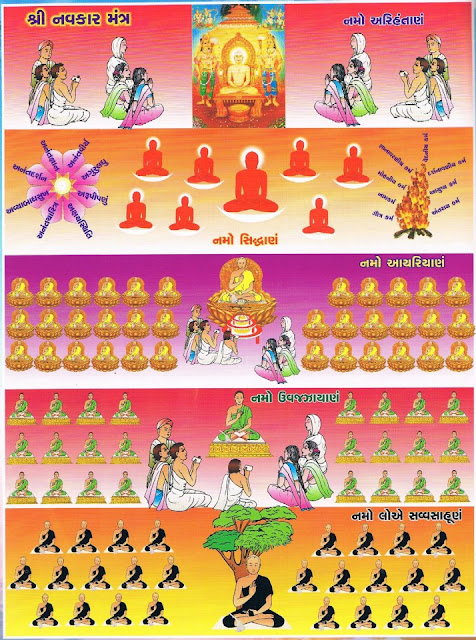
Let us first listen to Navkar Mahamantra / Namaskar Mahamantra to begin

The virtues of the Siddha Chakra are so many, we cannot describe them.
They fulfil the desires of the worshipper.
We pray to them a thousand times.

About Navpad Oli - Jain Festival

Navpad and Navapad Oli holds great significance in Jainism. It is one of the most important religious festivals of the Jain community. Navpad Oli comes twice a year - in Chaitra (March/April) and Ashwin (September/October). Devotees observe Ayambil Tap during the nine days of Navpad Oli.

The festival falls exactly between Shukla Saptami (Seventh lunar day) and Purnima (Full moon day) in both Ashwina and Chaitra months. Navapad Oli starts in the middle of Navratri. Both Navapad Olis fall among the five Shaswata Atthai of Jain. The remaining three Atthai are Chaturmasik Atthai (observed thrice a year).

Jains perform Ayambil Tapa for nine days to salute the nine supreme posts in the universe. Ayambil is a special type of fast in which one eats only boiled grains once a day. It is not permitted to add anything - including salt - to the boiled grains. Hence it is considered very difficult for a layman to perform Ayambil Tap.

The earth's day and night are almost equal during March-April and September-October - the seasons of Navapad Oli. These are moderate seasons perfectly suitable for worshipping the supreme powers of the universe. Devotion and Navpad prayer keeps us mentally healthy, whereas Ayambil and penance energizes us physically.

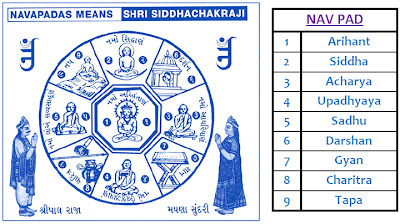
Nava means nine in Sanskrit and Prakrit languages and Pada means post. Hence Navapada means nine supreme posts of the universe.

These nine are: ARIHANT, SIDDHA, ACHARYA, UPADHYAYA, SADHU, SAMYAG DARSHAN, SAMYAG GYAN, SAMYAG CHARITRA and SAMYAG TAPA.

Navapad is also called SIDDHA CHAKRA.

Siddhachakra Yantra - Sacred Jain diagram with 9 Pads of Navapad

SIDDHA CHAKRA YANTRA

Panch Parmeshti - Five Supreme Beings in Jainism - Arihant Siddha Acharya Upadhyaya Sadhu

PANCH PARMESHTI PAD

Siddhachakra Mahayantra - Complete sacred Jain diagram with all 9 Navapad positions

SIDDHACHAKRA MAHAYANTRA - Explanation of Design

Jain devotees performing Samuh Ayambil Tap together during Navapad Oli festival

NAVAPAD - Community Ayambil

Speciality of Navapad

The first five posts of Navapad are called Panch Parameshthi, where Param means ultimate or supreme and Esthi means to worship. These five are the eternal powers to be worshipped.

Arihant and Siddha are Deva Tatva (God Principle). Acharya, Upadhyaya and Sadhu are Guru Tatva (Preacher Principle). The last four Pads of Navapad are great virtues depicted as Dharma Tatva (Spirituality Principle) in Jainism. One can attain Moksha (salvation) by observing those virtues. Arihant and Siddha - the first two posts - have accomplished these four virtues. Acharya, Upadhyaya and Sadhu are on the path of accomplishing them.

The Siddhachakra is a Yantra in circular shape. Siddha is placed at the top. Arihant is in the center. Acharya is at the right side of Arihant. Upadhyaya is in the lower side and Sadhu in the left side. Samyag Darshan, Samyag Jnyan, Samyag Charitra and Samyag Tapa are placed in four corners starting from upper right and moving clockwise.

Generally the first five (Panch Parameshthi) are placed in the form of idols and the next four by name only.

Ritual of the Navpad Oli - Daily Worship Numbers

No. Name of the Pad Kayotsarga (Logassa) Khamasanas Swastiks Navkarvalis
1. Aum Rhim Namo Arihantanam 12121220
2. Aum Rhim Namo Siddhanam 08080820
3. Aum Rhim Namo Aayariyanam 36363620
4. Aum Rhim Namo Uvajzayanam 25252520
5. Aum Rhim Namo Loe Savva Sahunam 27272720
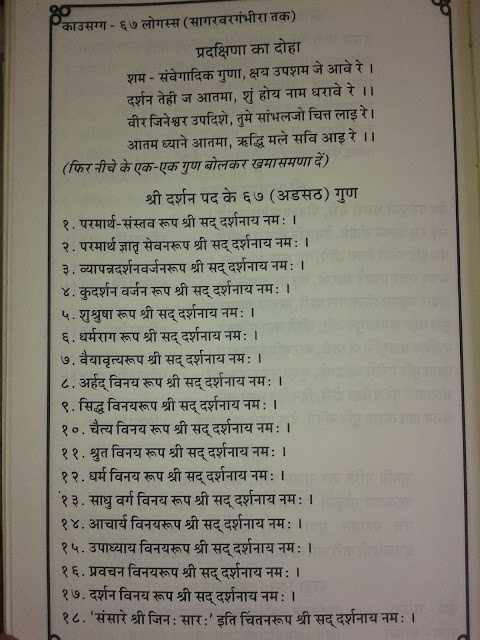
6. Aum Rhim Namo Dansanassa 67676720
7. Aum Rhim Namo Nanassa 51515120
8. Aum Rhim Namo Charittassa 70707020
9. Aum Rhim Namo Tavvasa 50505020

Inspiring Pravachans on Each Pad - by Jain Acharya

Below are inspiring pravachans on each Pad by Jain Acharya.

Day 1 - Arihant Pad (Shukla Saptami)

Arihant Pad is the first post of Navapad, placed in the center of Siddhachakra Yantra. It falls among Deva Tatva. Arihant is the supreme power of nature - the purest soul in the universe with a physical body. Ari means enemy and Hant means destroyer. The enemies here are internal - Raga (craving/attachment) and Dvesha (hatred). Hence Arihant is free from earthly attachments and referred to as Veetraga.

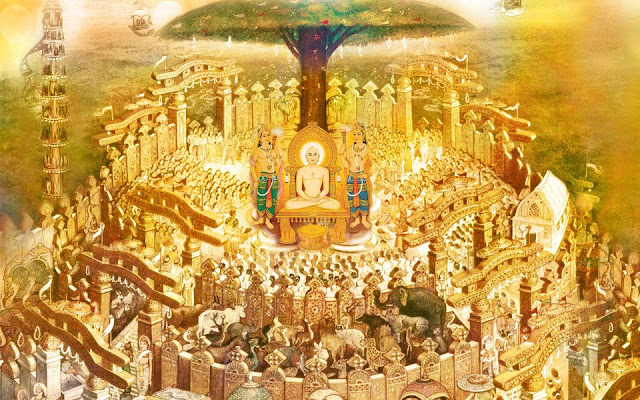
Arihant has complete wisdom - Kevala Jnyana. He preaches true spirituality in a Samavasharan and establishes the Chaturvidha Sangha - Sadhu (Monks), Sadhwi (Nuns), Shravaka (Household followers, Male) and Shravika (Household followers, Female). Because he establishes the Teertha, he is also called Tirthankar. He has twelve supreme attributes and is symbolized by the color white.

Jain followers worship Arihant Pada on the first day of Navapad Oli. They perform Ayambil by eating boiled rice only (white - matching Arihant's color).

Lord Mahavir - 24th Tirthankara of Jainism - Arihant Pad Navpad Oli

ARIHANT PAD - Lord Mahavir Swami

Pravachan Audio - Day 1 Arihant Pad

Day 1 - Arihant Pad Pravachan by Jain Acharya


Download - Day 1 Arihant Pravachan

Arihant Pad - Chaityavandan, Stavan and Stuti Vidhi

Shree Navpad Oli Vidhi - Arihant Pad Day 1 Chaityavandan Stavan and Stuti guide

SHREE NAVPAD OLI VIDHI - ARIHANT PAD

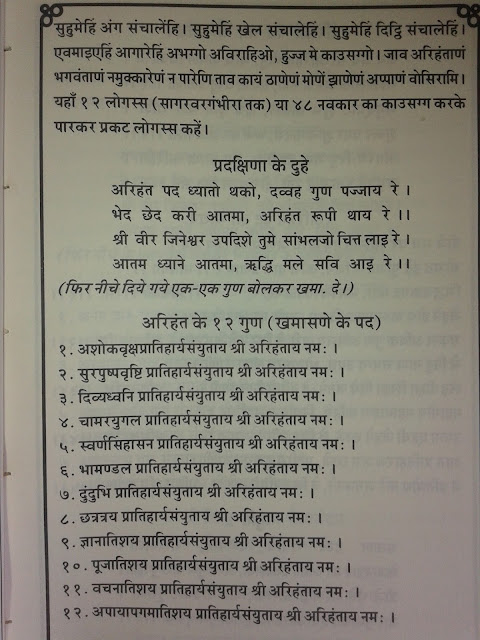
Arihant Pad 12 Khamasana and Pradakshina - Navpad Oli Siddhachakra Vidhi

ARIHANT PAD - 12 KHAMASANA AND PRADAKSHINA

Siddhachakra Arihant Pad Chaityavandan Stavan and Stuti ceremony photo

SIDDHACHAKRA - ARIHANT PAD CHAITYAVANDAN STAVAN AND STUTI

Day 2 - Siddha Pad (Shukla Astami)

Siddha Pad is the second post of Navapad, placed at the top of Siddhachakra Yantra. It is also Deva Tatva. Siddha is the supreme power of nature - the purest soul in the universe without a physical body. One becomes Siddha after attaining salvation. The Siddha is a Veetraga and universal observer but does not preach as he has no physical body. He lives in perfect equilibrium, eternal peace and joy and remains in perfect motionless rest.

Siddha is free from all Karmic bondage, hence there is no reincarnation. He lives forever above the Siddha Shila at the top of the Universe. He has eight supreme attributes and is symbolized by the color red.

Jain followers worship Siddha Pada on the second day. They perform Ayambil by eating boiled wheat only (red - matching Siddha's color).

Siddha Shila - Abode of liberated souls in Jain cosmology above the universe

SIDDHA PAD - SIDDHA SHILA

Pravachan Audio - Day 2 Siddha Pad

Day 2 - Siddha Pad Pravachan by Jain Acharya


Download - Day 2 Siddha Pravachan

Siddha Pad - Chaityavandan, Stavan and Stuti Vidhi

Siddha Pad Khamasana and Pradakshina during Navpad Oli Siddhachakra ceremony

SIDDHA PAD - KHAMASANA AND PRADAKSHINA

Siddhachakra Siddha Pad Stuti and Stavan text for Navpad Oli Chaityavandan

SIDDHACHAKRA - SIDDHA PAD CHAITYAVANDAN STAVAN AND STUTI

Day 3 - Acharya Pad (Shukla Navami)

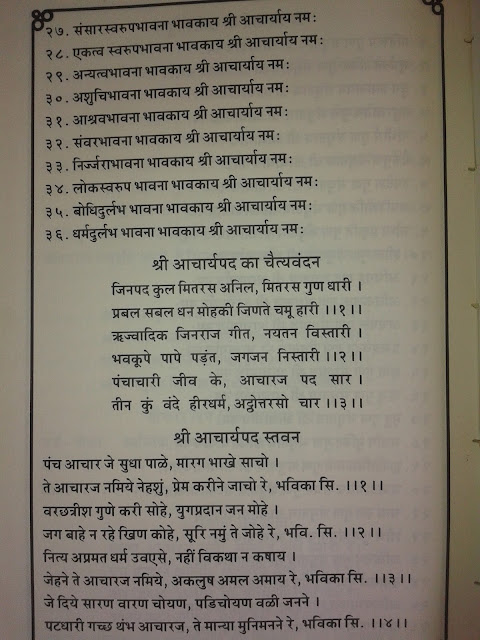
Acharya Pad is the third post in Navpad, placed at the right side of Arihant in Siddhachakra Yantra. He is the first among Guru Tatva. Acharya is the successor of Arihant and leader of the fourfold Sangh. He is the Supremo and ultimate decision-making authority in all Sangha matters in the absence of Arihant. He is also the ultimate authority in interpretation of the Jain Agam (Holy Scriptures).

He observes and motivates Monks and Nuns for five spiritual conducts - Jnyanachara, Darshanachara, Charitrachara, Tapachara and Veeryachara. The first four relate to the last four Padas of Siddhachakra. Veeryachara is the enthusiasm and power to observe all four. Acharya has thirty six attributes and symbolizes by golden yellow color.

Jain followers worship Acharya Pada on the third day. They perform Ayambil by eating boiled gram only (yellow - matching Acharya's color).

Acharya Pad - Jain Ganadhar - Supreme leader of Chaturvidha Sangha

ACHARYA PAD

Pravachan Audio - Day 3 Acharya Pad

Day 3 - Acharya Pad Pravachan by Jain Acharya


Download - Day 3 Acharya Pravachan

Acharya Pad - Chaityavandan, Stavan and Stuti Vidhi

Siddhachakra Acharya Pad Pradakshina and worship during Navpad Oli

SIDDHACHAKRA - ACHARYA PAD PRADAKSHINA

Acharya Pad 36 Khamasana devotees during Navpad Oli Siddhachakra

SIDDHACHAKRA - ACHARYA PAD 36 KHAMASANA

Acharya Pad Chaityavandan and Stuti ceremony during Navpad Oli

SIDDHACHAKRA - ACHARYA PAD CHAITYAVANDAN AND STUTI

Acharya Pad Stuti text and prayers for Navpad Oli

SIDDHACHAKRA - ACHARYA PAD STUTI

Day 4 - Upadhyaya Pad (Shukla Dasami)

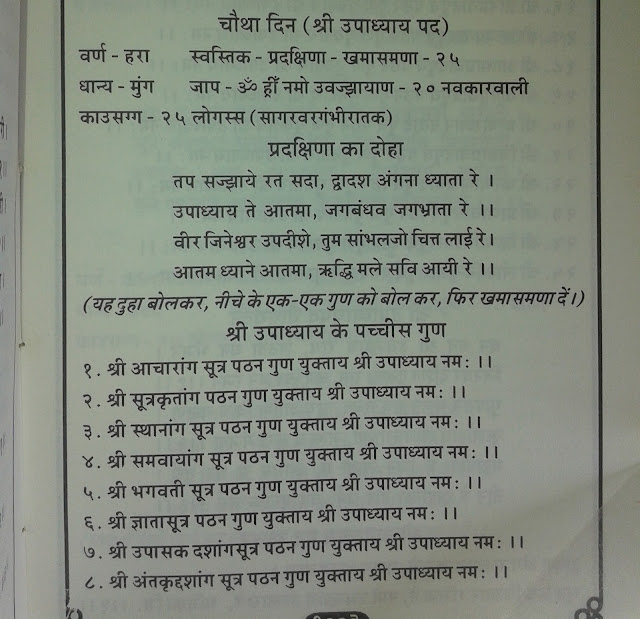
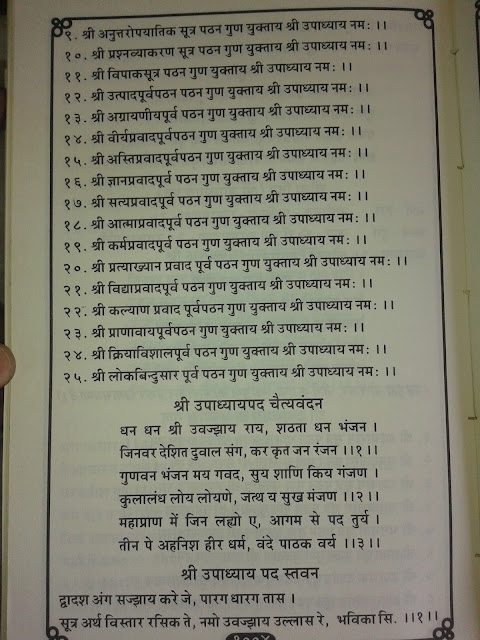
Upadhyaya Pad is the fourth post in Navpad, placed in the lower side of Arihant in Siddhachakra Yantra. He is the second among Guru Tatva. He is supposed to know all Jain Agams - eleven Anga and fourteen Purva (twenty five in all). These are his twenty five attributes. He is responsible for academic activities in the Sangha. He preaches and teaches Monks and Nuns. He is like a lieutenant and minister of Acharya. Some sacred Jain scriptures describe him as a Prince in the kingdom of Acharya.

Upadhyaya is symbolized by the color green. Jain followers worship Upadhyaya Pada on the fourth day and perform Ayambil by eating boiled Mung only (green - matching Upadhyaya's color).

Upadhyaya Pad - Jain teacher of monks and nuns in Chaturvidha Sangha

UPADHYAYA PAD

Pravachan Audio - Day 4 Upadhyaya Pad

Day 4 - Upadhyaya Pad Pravachan by Jain Acharya


Download - Day 4 Upadhyaya Pravachan

Upadhyaya Pad - Chaityavandan, Stavan and Stuti Vidhi

Upadhyaya Pad Khamasana and Pradakshina during Navpad Oli Siddhachakra

SIDDHACHAKRA - UPADHYAYA PAD KHAMASANA AND PRADAKSHINA

Siddhachakra Upadhyaya Pad Chaityavandan and Stavan during Navpad Oli

SIDDHACHAKRA - UPADHYAYA PAD CHAITYAVANDAN AND STAVAN

Upadhyaya Pad Stuti and Chaityavandan text for Navpad Oli

SIDDHACHAKRA - UPADHYAYA PAD STUTI

Day 5 - Sadhu Pad (Shukla Ekadashi)

Sadhu Pad is the fifth post in Navpad, placed in the left side of Arihant in Siddhachakra Yantra. He is the third among Guru Tatva. He has renounced household life and devoted himself to the holy path preached by Arihant and disciplined by Acharya. He devotes himself for the noble path that leads to salvation and practices four sacred virtues.

He has five supreme vows - completely abstaining from:

  1. Violence
  2. Lying
  3. Stealing
  4. Sexual conduct
  5. Possessions of earthly things

He practices living in equilibrium in all conditions. He walks bare foot and uses no vehicles. He does not cook for himself or others and lives on food provided by households. He does not keep money or earthly assets. He practices austerity and penance to his optimum capacity under the discipline of Acharya and Upadhyaya. He has twenty seven attributes and is symbolized by the color black.

Jain followers worship Sadhu Pada on the fifth day. They perform Ayambil by eating boiled Udad only (black - matching Sadhu's color).

Jain Sadhu Monk - renounced worldly life - Sadhu Pad Navpad Oli

SADHU PAD

Pravachan Audio - Day 5 Sadhu Pad

Day 5 - Sadhu Pad Pravachan by Jain Acharya


Download - Day 5 Sadhu Pravachan

Sadhu Pad - Chaityavandan, Stavan and Stuti Vidhi

Sadhu Pad Khamasana and Pradakshina during Navpad Oli Siddhachakra

SIDDHACHAKRA - SADHU PAD KHAMASANA AND PRADAKSHINA

Sadhu Pad Khamasana ceremony photo during Navpad Oli

SIDDHACHAKRA - SADHU PAD KHAMASANA

Sadhu Pad Stuti and Stavan text for Navpad Oli Chaityavandan

SIDDHACHAKRA - SADHU PAD CHAITYAVANDAN STAVAN AND STUTI

Day 6 - Samyag Darshan Pad (Shukla Dwadashi)

Samyag Darshan - Samyag is a Sanskrit word meaning "right" and Darshan means "view." Hence Samyag Darshan means Right View. It is also described as faith in the preachings of Arihant. This is the sixth Pad of Siddhachakra and first of Dharma Tatva. This is the root of all Dharma (Spirituality). Dharma starts with the right view and perspective. All knowledge is like ignorance without Samyag Darshan.

This is the first among Ratna Trayee (Three Gems) of Jainism to attain salvation. It has sixty seven attributes and symbolizes with white color.

Jain followers worship Samyag Darshan Pada on the sixth day. They perform Ayambil by eating boiled rice only (white color).

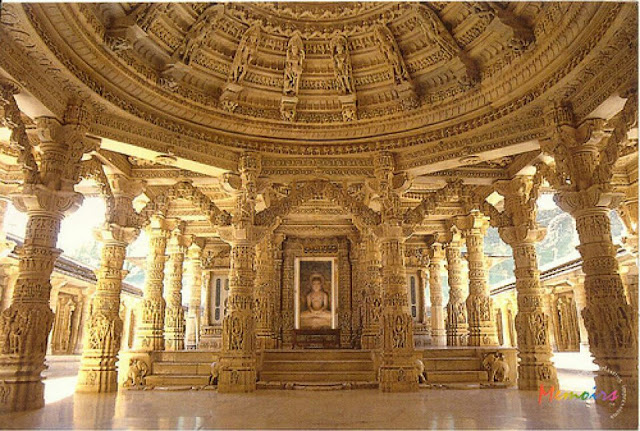
Jain Temple - Samyag Darshan - Right Faith and Right Vision in Jainism

SAMYAG DARSHAN - RIGHT FAITH AND VISION

Pravachan Audio - Day 6 Samyag Darshan Pad

Day 6 - Samyag Darshan Pad Pravachan by Jain Acharya


Download - Day 6 Samyag Darshan Pravachan

Darshan Pad - Chaityavandan, Stavan and Stuti Vidhi

Darshan Pad Khamasana and Pradakshina during Navpad Oli Siddhachakra

SIDDHACHAKRA - DARSHAN PAD KHAMASANA AND PRADAKSHINA

67 Khamasana of Darshan Pad during Navpad Oli Ayambil ceremony

SIDDHACHAKRA - DARSHAN PAD 67 KHAMASANA AND PRADAKSHINA

Darshan Pad Khamasana prayer during Navpad Oli Siddhachakra

SIDDHACHAKRA - DARSHAN PAD KHAMASANA

Darshan Pad Khamasana and Chaityavandan during Navpad Oli

SIDDHACHAKRA - DARSHAN PAD KHAMASANA AND CHAITYAVANDAN

Darshan Pad Pradakshina during Navpad Oli Siddhachakra ceremony

SIDDHACHAKRA - DARSHAN PAD PRADAKSHINA

Day 7 - Samyag Jnyana Pad (Shukla Trayodashi)

Samyag Jnyana - Jnyana (Gyana) means knowledge. Hence Samyag Jnyana refers to Right Knowledge, also called wisdom. This is the seventh Pad of Siddhachakra and second of Dharma Tatva. All actions should be preceded by right knowledge. One cannot discriminate between right and wrong without right knowledge.

This is the second among Ratna Trayee (Three Gems) of Jainism to attain salvation. It has five sub-divisions and fifty one attributes and symbolizes with white color.

Jain followers worship Samyag Jnyana Pada on the seventh day. They perform Ayambil by eating boiled rice only (white color).

Samyag Gyan - Right Knowledge - second gem of Jain Ratna Trayee

SAMYAG GYAN - RIGHT KNOWLEDGE

Kalpasutra - Mahavira Nirvana illustration - ancient Jain scripture

KALPASUTRA - MAHAVIRA NIRVANA (GYAN)

Pravachan Audio - Day 7 Samyag Gyan Pad

Day 7 - Samyag Gyan Pad Pravachan by Jain Acharya


Download - Day 7 Samyag Gyan Pravachan

Gyan Pad - Chaityavandan, Stavan and Stuti Vidhi

Gyan Pad Khamasana and Pradakshina during Navpad Oli Siddhachakra

SIDDHACHAKRA - GYAN PAD KHAMASANA AND PRADAKSHINA

Gyan Pad Khamasana and Chaityavandan during Navpad Oli

SIDDHACHAKRA - GYAN PAD KHAMASANA AND CHAITYAVANDAN

Day 8 - Samyag Charitra Pad (Shukla Chaturdashi)

Samyag Charitra - Charitra means action or conduct. Hence Samyag Charitra refers to Right Action or Right Conduct. This is the eighth Pad of Siddhachakra and third of Dharma Tatva.

This is the third among Ratna Trayee (Three Gems) of Jainism to attain salvation. It has seventy attributes and symbolizes with white color.

Jain followers worship Samyag Charitra Pada on the eighth day. They perform Ayambil by eating boiled rice only (white color).

Lord Mahavir Swami - Samyag Charitra - Right Conduct third gem of Jainism

SAMYAG CHARITRA - RIGHT CONDUCT

Pravachan Audio - Day 8 Samyag Charitra Pad

Day 8 - Samyag Charitra Pad Pravachan by Jain Acharya


Download - Day 8 Samyag Charitra Pravachan

Charitra Pad - Chaityavandan, Stavan and Stuti Vidhi

Charitra Pad ceremony during Navpad Oli Siddhachakra

CHARITRA PAD

Charitra Pad Khamasana during Navpad Oli ceremony

CHARITRA PAD - KHAMASANA

Charitra Pad Navpad Oli prayer and Pradakshina

CHARITRA PAD

Charitra Pad devotional ceremony during Navpad Oli

CHARITRA PAD

Day 9 - Samyag Tapa Pad (Shukla Purnima - Final Day)

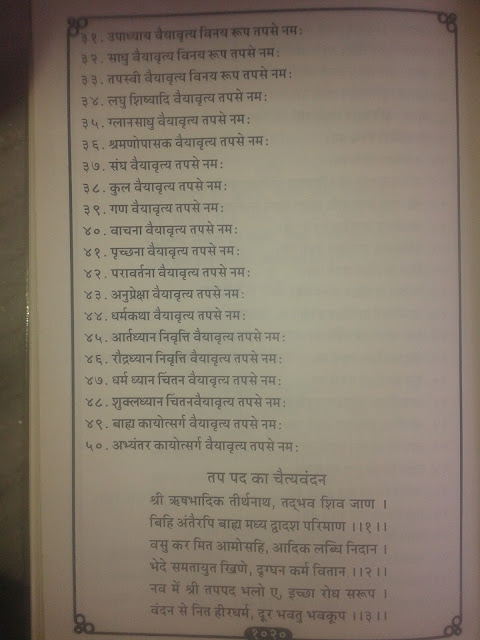
Samyag Tapa - Tapa means austerity or penance. Samyag Tap means austerity in the right perspective and direction. It is the last Pad of Navapad. Jain holy scriptures describe Tap as abstaining from lusts and desires. The goal of austerity is reaching equilibrium and tranquility.

There are two types of austerity - internal and external, each further classified into six types. Fast and penance are among externals. Modesty, nursing and meditation are among the internals. Observing internal austerity is more valuable than externals. It has fifty attributes and symbolizes with white color.

Jain households, Monks and Nuns worship Samyag Tapa Pada on the ninth and final day of Navapad Oli. They perform Ayambil by eating boiled rice only (white color).

Lord Mahavir in meditation - Samyag Tapa - Right Austerity last Pad of Navapad

SAMYAG TAPA - RIGHT AUSTERITY

Pravachan Audio - Day 9 Samyag Tapa Pad

Day 9 - Samyag Tapa Pad Pravachan by Jain Acharya


Download - Day 9 Samyag Tapa Pravachan

Tapa Pad - Chaityavandan, Stavan and Stuti Vidhi

Tap Pad ceremony during Navpad Oli Siddhachakra final day

TAP PAD

Tap Pad Khamasana during Navpad Oli Purnima final day

TAP PAD

Tap Pad prayer and worship during Navpad Oli

TAP PAD

Tap Pad devotional ceremony on Purnima during Navpad Oli final day

TAP PAD

Navkar Mantra - Devotional Songs and Stavan

Siddhagiri Na Shikharo Bole Om Namo Arihantam


Download - Siddhagiri Na Shikharo Bole

Samro Mantra Bhalo Navkar


Download - Samro Mantra Bhalo Navkar

Navkar Mantra Hain Pyara - by Lata


Download - Navkar Mantra Hain Pyara

Mantra Navkar Che Mangalkari


Download - Mantra Navkar Che Mangalkari

Shripal - Maina Sundari Amar Katha

To listen to the Shripal-Maina Sundari Katha, click the link below:

Shripal - Maina Sundari Amar Katha


Download - Shripal-Maina Sundari Katha

Download All Navpad Oli Songs from Google Drive

Click below to access the complete collection of all Navpad Oli songs and pravachans:

Click Here to Download All Songs

Note: Click on the song name or the down-arrow icon inside the folder to download individual files.

Navkar Mahamantra - Closing Prayer

Sab Tapasvi Sukh Shata Main Rahejo
Jainam Jayati Shashnam

Reference: Original post - Jain Festival Navpad Oli by Jyoti Kothari

Saturday, April 6, 2013

JAIN STAVAN: LIFE OF MAHAVIR SWAMI: KATHA SU AAYO HIRO

JAIN STAVAN: LIFE OF MAHAVIR SWAMI: KATHA SU AAYO HIRO


JAI JINENDRA,
THIS STAVAN IS ABOUT THE LIFE OF MAHAVIR SWAMI AND THE PANCH (FIVE) KALYANAKS WHICH HAPPEN IN EACH AND EVERY TIRTHANKAR'S LIFE.
ALSO VARIOUS EVENTS OF MAHAVIR SWAMI'S LIFE ARE ALSO SHOWN IN THIS STAVAN.

Panch mean -five and Kalyanak mean -for the betterment of all living beings.


1) Garbha-Kalyanak or Inception ceremony:
·         Six months before the inception & during the nine months of pregnancy Indra Kuber showers precious jewels in the city.
·         Saudharm Indra assembles his cabinet & celebrates the joyous day.
·         Eight young girls celebrate the day with the mother with music & dances.
·         Garbha Kalyanak Pooja is done during the day.
·         Mother witnesses 16 dreams this night.
·         In the evening King’s (father) cabinet assembles, the king explains the meaning of all her dreams.
·         56 (DIPKUMARIS)young girls present the mother with the gifts through joyous dances.

2) Janma Kalyanak: Birth ceremony

·         Saudharm Indra celebrates the birth by making three circles of celebration hall.
·         The Birth is celebrated with songs & dances.
·         Sachi Indrani brings the child from the mother & enjoys the presence of child Bhagwan with dances.
·         Saudharm Indra wants to have the child desperately, once Sachi Indrani gives him the child, he enjoys the aura with his thousand eyes & still remains unsatisfied.
·         Saudharm Indra takes the newborn Bhagwan to Mount Meru on Aravat elephant in a large procession.
·         At Mount Meru the Bhagwan’s Abhishek is done with 1008 Kalash
·         Janma Kalyanak Pooja is done during the day.
·         Saudharm Indra celebrates the joyous occasion with Taandav dance to honor Tirthankar’s birth.
·         In the evening everyone enjoys the opportunity of swinging the child God in a magnificent swing created by heavenly Gods.
·         Child God’s birth is celebrated for the spiritual fulfillment, as this is His last birth.


3) Diksha Kalyanak: Renunciation ceremony

·         In the King’s assembly the young prince declares his intention of renouncing the worldly life and the parents accept this decision with joy.
·         Lokantik angles praise the renunciation thoughts of the prince.
·         Procession of the prince to jungle.
·         Discussion between Indras & Kings as to who has the right to carry the Palaki (coach).
·         Process of Aahardaan (first meal after Diksha).
·         Diksha Kalyanak Pooja is performing during the day.
·         Behind the closed doors special processes are done to the statue.

4) Keval Gyan Kalyanak: Omniscience celebration

·         Celebration of Keval Gyan by all, with music & dances.
·         Creation of Samosaran by heavenly Indra.
·         Divya- Dhawni (sermons) and questions by Gandhar’s.
·         Keval Gyan Kalyanak Pooja.
·         Behind the close doors Keval Gyan process is done to all the statues and at this point the doors are opened because after achieving Keval Gyan the statues are now transformed in to Gods.

5): Moksh Kalyanak: Celebration of liberation
·         Declaration of Moksh & celebrations with loud musical instruments & dances.
·         Evaporation of physical body in presence of heavenly Indra Agnikumar.
·         Nirvan Kalyanak Pooja.
·         Shanti havan.

JAINAM JAYATI SHASHNAM.

Wednesday, March 13, 2013

JAIN STAVAN : MERE GHAR KEH AAGE AADINATH TERA MANDIR BAN JAAYE

JAIN STAVAN : MERE GHAR KEH AAGE AADINATH TERA MANDIR BAN JAAYE

 
 To download this song click HERE

JAI JINENDRA,

THIS STAVAN IS ABOUT A DEVOTEE FEELING FOR HIS GOD THAT IT WOULD BE SO SO NICE IF THERE WOULD BECOME A TEMPLE IN FRONT OF HIS HOUSE

MERE GHAR KEH AAGE AADINATH TERA MANDIR BAN JAAYE 
JAB KHIDKI KHOLU TOH TERA DARSHAN H JAYE

*******MERE GHAR KE AAGE AADINATH TERA MANDIR BAN JAAYE**********
मेरे घर के आगे आदिनाथ तेरा मंदिर बन जाए 

મેરે ઘર કે આગે આદિનાથ તેરા મંદિર બન જાયે...
જબ ખિડકી ખોલું તો તેરા દર્શન હો જાયે..
મેરે ઘર કે..મેરે ઘર કે..મેરે ઘર કે આગે આદિનાથ તેરા મંદિર બન જાયે...

કરું રોઝ પૂજા તેરી ધૂપ દીપ જલાઉ મેં..
ફૂલોં કી માલા સે અંગિયા ભી રચાઉં મેં...
મેરે ઘર કે..મેરે ઘર કે..મેરે ઘર કે આગે આદિનાથ તેરા મંદિર બન જાયે...
જગમગ જગમગ દિયો સે તેરા મંદિર સજ જાયે...
જબ ખિડકી ખોલું તો તેરા દર્શન હો જાયે..

જબ ખિડકી ખોલું તો તેરા દર્શન હો જાયે..


જબ આરતી હો તેરી મુજે ઘંટ સુનાઈ દે..

મુજે રોઝ સવેરે આદિનાથ તેરી સુરત દિખાઈ દે..
મેરે ઘર કે..મેરે ઘર કે..મેરે ઘર કે આગે આદિનાથ તેરા મંદિર બન જાયે...


જબ ભક્તિ કરે મિલકર રસ કાનો મેં ઘુલ જાયે..

મેરે ઘર કે..મેરે ઘર કે..મેરે ઘર કે આગે આદિનાથ તેરા મંદિર બન જાયે...
આતે જાતે દાદા તુમકો મેં પ્રણામ કરું..

જો મેરે લાયક હો કુછ ઐસા કામ કરું..

તેરી સેવા કરને સે મેરી કિસ્મત ખુલ જાયે..

જબ ખિડકી ખોલું તો તેરા દર્શન હો જાયે..

નઝદીક રહેંગે તો આના જાના હોગા..
મેરે ઘર કે..મેરે ઘર કે..મેરે ઘર કે આગે આદિનાથ તેરા મંદિર બન જાયે...
અબ ભક્તો દાદા મિલના જુલના હોગા..

સબ સાથ રહે દાદા જલ્દી વો દિન આયે..
જબ ખિડકી ખોલું તો તેરા દર્શન હો જાયે..

IF YOU ARE INTERESTED IN LIST OF ALL THE SONGS TO DOWNLOAD  JUST CLICK THE BELOW HIGHLIGHTED BUTTON TO DOWNLOAD FROM GOOGLE DRIVE
Note : Click HERE to download from google drive and click on the song or down arrow 
to download it

JAINAM JAYATI SHASHNAM