Below are the links to a movie on Mayna Sundari and Sripal Raja
IF YOU ARE INTERESTED IN THE ESSENCE OF NAVPAD OLI CLICK HERE
At one time, the kingdom of Champanagar was ruled by King Singhrath, who had a son named Shripal by his queen, Kamal-prabha. When Shripal was five years old, his father died. King Singhrath’s ambitious brother, Ajitsen, took this opportunity to seize the throne. In order to make his position as King secure, he was keen to get rid of Shripal. When Kamal-prabha became aware of Ajitsen’s vicious plan, she fled from Champanagar with her son. Learning about her escape, Ajitsen sent his trusted soldiers to pursue her. As the soldiers got close, she did not know how to save her son. She saw a group of lepers, and in desperation, she asked them to take her son into their custody. They warned her about the risk of her son contracting the disease of leprosy from them. However, she had no choice if she wanted to save her son, so she entrusted her son to them. Shripal grew up to be very bold and handsome. The people of the leper colony became very fond of him and took great care of Shripal. Ultimately, Shripal contracted leprosy. When he became a youth, the people made him their leader, and named him Umar Rana. Under his leadership the group traveled from place to place and one day arrived at the city of Ujjayini, the capital of the Malwa region. King Prajapal was ruling there. He and Queen Rupsundari had two intelligent and beautiful daughters, Sursundari and Mayana-sundari. The King loved both of them and made adequate arrangements for their training in the arts and crafts, which the girls mastered in due course. One day, the King decided to test their knowledge and called them in the assembly hall. He asked a number of questions to Sursundari who gave satisfactory replies to all of them. At the end, the King asked her by whose favor she got all her skills and also the amenities and luxuries that she enjoyed. The girl humbly replied that she gained all that by the King’s favor. Pleased with her replies, the King decided to reward her appropriately. Then, he asked several questions to Mayana-sundari. She too gave satisfactory replies to all his questions. At the end, the King asked her the same question that he had asked Sursundari. He had expected Mayana to give an identical reply and thus please him. However, Mayana had total faith in the religious philosophy she had studied at length. She firmly believed that everything that she had received had been the result of her karma. She must have earned good karma in the past that resulted in the happy situations that she was undergoing. If she did not have that karma to her credit, no one could bestow happiness on her. She therefore replied: “O father! The great King! With due respect to you, all the comfort that you provide me are only because of my meritorious (Punya) karma. Everyone gets whatever is written in his or her destiny due to his or her karma. You yourself cannot give or take away anything.” Everything that she had received had been the result of her Karma. She must have earned good Karma in the past that resulted in the happy situations that she was undergoing. If she did not have that Karma to her credit, no one could bestow happiness on her. The King was exasperated to hear the unexpected reply. He repeatedly asked her to consider how she could have obtained anything without his generosity. Mayana replied that everything, right from her being born as his daughter up to her present situation, could occur solely as a consequence of her good or bad karmas, and no one could have made any difference. The King grew angry with her unexpected persistence. He could not believe that the girl could have received anything without his favor, and did not agree that everything happens according to one’s own karma. He therefore decided to teach her a lesson, and asked his men to find the ugliest man in Ujjayini. The men spotted Umar Rana and brought him to the court. In utter disdain, the King instantly got Mayana married to Umar. He gave them some basic things and a small house and asked Mayana to undergo the result of her karma. Rupsundari was very unhappy at the sudden turn of events in her daughter’s life, but she could not speak against her husband’s will. On the other hand, the King looked for a suitable match for Sursundari in appreciation of her replies and had her married to prince Aridaman of Shankhapuri.
Princess Mayana marrying Shripal
Mayana was deeply religious. She accepted Shripal in the guise of Umar as her husband and took care of him. She went to temples and heard the sermons of monks along with him. One day, Mayana-sundari and her husband went to see acharya Munichandra and talked to him about their problems and his leprosy disease. The acharya was a well-known scholar of the time. He advised them to go through the penance of ayambil Oli, known as Navapad (nine pious entities) penance, which can cure all types of diseases. The Navapad aradhana (puja) is observed by meditation and practicing a penance called ayambil. ayambil is observed by having only one meal a day of very plain food without any spices, milk, sugar, salt, oil, butter, fruits, or vegetables (sometimes minor exceptions are made by gurus for certain spices). Meanwhile, one meditates upon the Navapad: Arihanta, Siddha, acharya, Upadhyay, Sadhus (Pancha Parmesthi), Jnan (knowledge), Darshan (faith), Charitra (conduct), and Tapa (penance). This penance and meditation is to be observed for nine days, twice a year, during the month of March/April (Chaitra) and September/October (Ashwin). The couple was to do this penance for four and half years, resulting in Nine ayambil Olis (one every six months). Accordingly, Mayana and Shripal devoutly observed the Navapad worship and penance with all its vitality. The result was miraculous. Shripal’s skin disease started fading, and in due course, he was totally cured of leprosy and regained the skin that he had before contracting the disease. Now he looked like the handsome prince that he had been. Mayana was very happy with this result and thanked her karma for that change too. Since the change was apparently brought about by devotion to Navapad and practicing the penance, both of them continued to observe it. Once, while they were at a temple, Queen Rupsundari saw them. She was shocked to see that her daughter was with a handsome man instead of the leper to whom she was married. Mayana understood her anxiety and explained in detail everything that had happened. Rupsundari was extremely pleased to hear that. She told the King that Mayana’s persistence about the theory of karma had been proven right. The King now realized the truth. Deep in his heart, he used to curse himself for bringing misery into his lovely daughter’s life. Now, he became happy and invited his daughter and son-in-law to stay with him in the palace. Shripal’s real identity was revealed to all, and by fortunate coincidence, his mother arrived at the palace and stayed with them. Once, there was a royal procession in which Shripal was seated on an elephant along with the King. During the procession, someone pointed a finger at Shripal and asked a relative who he was. The man replied that he was the King’s son-in-law. Shripal heard that and became sad that he was being identified by his relationship with his father-in-law. He felt that one should gain fame from one’s own efforts and not from association with relatives. He therefore secured permission from Mayana and the King and set off by himself on an auspicious day.
Shripal and Mayana are ardent worshippers of Navapad
He traveled far and wide, visited many places, and boldly faced the adversities that he encountered. During that period, he did not forsake his devotion to Navapad. Consequently, he successfully survived all the ordeals. As was the custom at that time, he married many girls and amassed great wealth and many followers.
Eventually, equipped with that, he came back and camped outside Ujjayini. His army was so large that it virtually surrounded the city; King Prajapal initially thought that some enemy had come with a large force to conquer Ujjayini. When he came to the camp, he was greatly pleased to recognize his son-in-law. Shripal then entered the city, where he was given a hero’s welcome. His mother and Mayana were anxiously awaiting his arrival and were very happy to see him. Shripal happily spent some time with Mayana, who was dearest to him. Then, he decided to regain his original kingdom of Champanagar. He sent a message to his uncle Ajitsen to leave the throne that he had seized. Ajitsen was, however, too proud to give it up. Therefore, Shripal invaded Champanagar with his vast army. Ajitsen put up a tough fight. However, his army was no match for Shripal’s. In the fight, Ajitsen was captured and Champanagar was taken over by Shripal, who then gracefully released his uncle from captivity. Ajitsen now felt that his days were almost over, and decided to renounce the worldly life. Thereafter, Shripal happily passed the rest of his life as the King of Champanagar. This story describes the faith of Mayanä-sundari on the philosophy of karma and her devotion to Navapad. It stresses the importance of her effort and determination to change her fate. Mayanä understood the nature of karma. However, she was not content with her fate. She and her husband, Shripäl, exerted their own self-efforts into prayer and practice to improve his condition and were ultimately successful. They accepted that karma had put them into their current condition, but they also knew that they could change their future if they only put effort into acquiring good karmas and destroying bad karmas. Happiness and misery are a state of mind regardless of the situation one is in. If you think you are miserable, then you will be miserable. Full faith in the theory of karma is essential to be content and happy.
Navpad Oli (Ayambil) - Jain Festival
|| Navapad Ayambil Oli || नवपद आयम्बिल ओली ||
Siddhachakra Tap - Navpad Pravachan
Let us first listen to Navkar Mahamantra / Namaskar Mahamantra to begin
The virtues of the Siddha Chakra are so many, we cannot describe them.
They fulfil the desires of the worshipper.
We pray to them a thousand times.
About Navpad Oli - Jain Festival
Navpad and Navapad Oli holds great significance in Jainism. It is one of the most
important religious festivals of the Jain community. Navpad Oli comes twice a year -
in Chaitra (March/April) and Ashwin (September/October).
Devotees observe Ayambil Tap during the nine days of Navpad Oli.
The festival falls exactly between Shukla Saptami (Seventh lunar day) and Purnima
(Full moon day) in both Ashwina and Chaitra months. Navapad Oli starts in the middle
of Navratri. Both Navapad Olis fall among the five Shaswata Atthai of Jain. The
remaining three Atthai are Chaturmasik Atthai (observed thrice a year).
Jains perform Ayambil Tapa for nine days to salute the nine supreme
posts in the universe. Ayambil is a special type of fast in which one eats only boiled
grains once a day. It is not permitted to add anything - including salt - to the boiled
grains. Hence it is considered very difficult for a layman to perform Ayambil Tap.
The earth's day and night are almost equal during March-April and September-October -
the seasons of Navapad Oli. These are moderate seasons perfectly suitable for worshipping
the supreme powers of the universe. Devotion and Navpad prayer keeps us mentally healthy,
whereas Ayambil and penance energizes us physically.
Nava means nine in Sanskrit and Prakrit languages and Pada
means post. Hence Navapada means nine supreme posts of the universe.
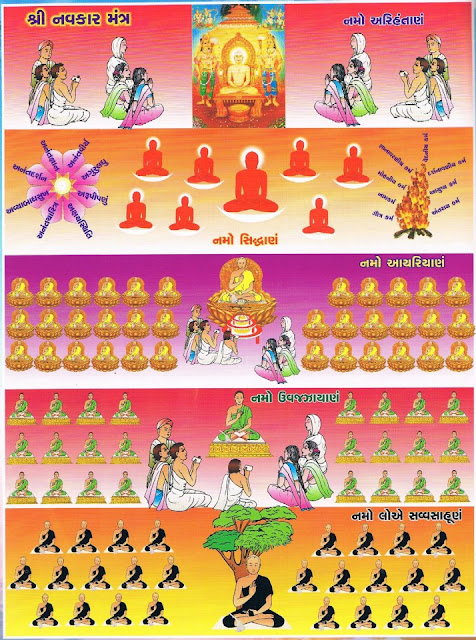
These nine are: ARIHANT, SIDDHA, ACHARYA, UPADHYAYA, SADHU,
SAMYAG DARSHAN, SAMYAG GYAN, SAMYAG CHARITRA and SAMYAG TAPA.
The first five posts of Navapad are called Panch Parameshthi, where
Param means ultimate or supreme and Esthi means to
worship. These five are the eternal powers to be worshipped.
Arihant and Siddha are Deva Tatva (God Principle). Acharya, Upadhyaya
and Sadhu are Guru Tatva (Preacher Principle). The last four Pads of
Navapad are great virtues depicted as Dharma Tatva (Spirituality
Principle) in Jainism. One can attain Moksha (salvation) by observing
those virtues. Arihant and Siddha - the first two posts - have accomplished these four
virtues. Acharya, Upadhyaya and Sadhu are on the path of accomplishing them.
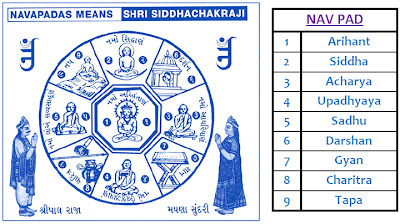
The Siddhachakra is a Yantra in circular shape. Siddha is placed at
the top. Arihant is in the center. Acharya is at the
right side of Arihant. Upadhyaya is in the lower side and
Sadhu in the left side. Samyag Darshan, Samyag Jnyan, Samyag Charitra
and Samyag Tapa are placed in four corners starting from upper right and moving clockwise.
Generally the first five (Panch Parameshthi) are placed in the form of idols and the
next four by name only.
Ritual of the Navpad Oli - Daily Worship Numbers
No.
Name of the Pad
Kayotsarga (Logassa)
Khamasanas
Swastiks
Navkarvalis
1.
Aum Rhim Namo Arihantanam
12
12
12
20
2.
Aum Rhim Namo Siddhanam
08
08
08
20
3.
Aum Rhim Namo Aayariyanam
36
36
36
20
4.
Aum Rhim Namo Uvajzayanam
25
25
25
20
5.
Aum Rhim Namo Loe Savva Sahunam
27
27
27
20
6.
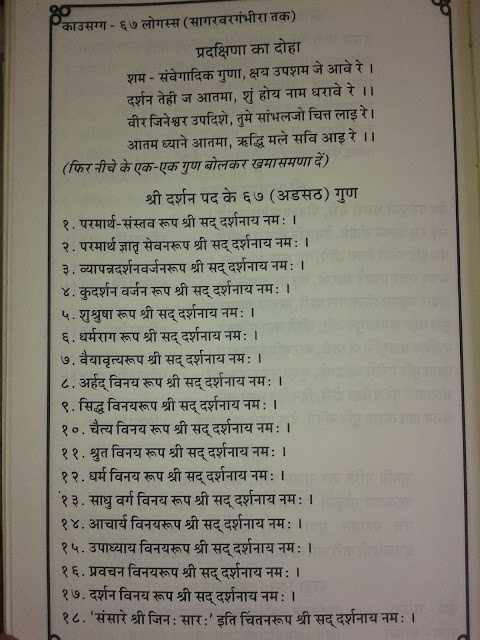
Aum Rhim Namo Dansanassa
67
67
67
20
7.
Aum Rhim Namo Nanassa
51
51
51
20
8.
Aum Rhim Namo Charittassa
70
70
70
20
9.
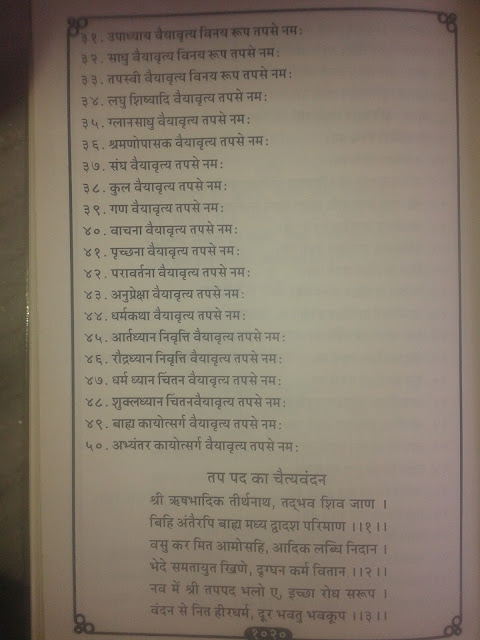
Aum Rhim Namo Tavvasa
50
50
50
20
Inspiring Pravachans on Each Pad - by Jain Acharya
Below are inspiring pravachans on each Pad by Jain Acharya.
Day 1 - Arihant Pad (Shukla Saptami)
Arihant Pad is the first post of Navapad, placed in the center of
Siddhachakra Yantra. It falls among Deva Tatva. Arihant is the supreme power of nature -
the purest soul in the universe with a physical body. Ari means enemy
and Hant means destroyer. The enemies here are internal -
Raga (craving/attachment) and Dvesha (hatred). Hence
Arihant is free from earthly attachments and referred to as Veetraga.
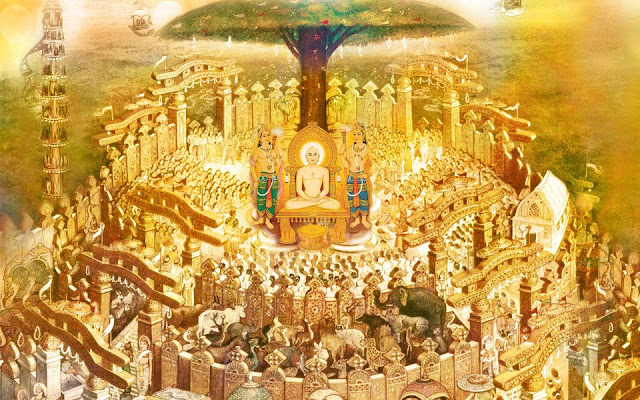
Arihant has complete wisdom - Kevala Jnyana. He preaches true
spirituality in a Samavasharan and establishes the
Chaturvidha Sangha - Sadhu (Monks), Sadhwi (Nuns), Shravaka
(Household followers, Male) and Shravika (Household followers, Female). Because he
establishes the Teertha, he is also called Tirthankar. He has twelve
supreme attributes and is symbolized by the color white.
Jain followers worship Arihant Pada on the first day of Navapad Oli. They perform
Ayambil by eating boiled rice only (white - matching Arihant's color).
Arihant Pad - Chaityavandan, Stavan and Stuti Vidhi
SHREE NAVPAD OLI VIDHI - ARIHANT PAD
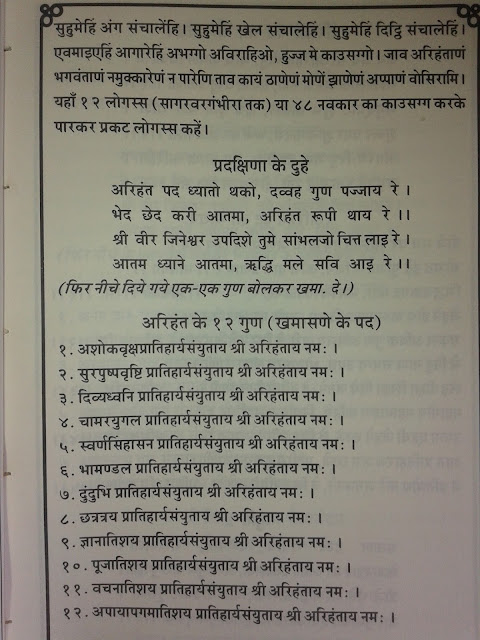
ARIHANT PAD - 12 KHAMASANA AND PRADAKSHINA
SIDDHACHAKRA - ARIHANT PAD CHAITYAVANDAN STAVAN AND STUTI
Day 2 - Siddha Pad (Shukla Astami)
Siddha Pad is the second post of Navapad, placed at the top of
Siddhachakra Yantra. It is also Deva Tatva. Siddha is the supreme power of nature -
the purest soul in the universe without a physical body. One becomes Siddha
after attaining salvation. The Siddha is a Veetraga and universal observer but does
not preach as he has no physical body. He lives in perfect
equilibrium, eternal peace and joy and remains in perfect motionless rest.
Siddha is free from all Karmic bondage, hence there is no reincarnation. He lives
forever above the Siddha Shila at the top of the Universe. He has
eight supreme attributes and is symbolized by the color red.
Jain followers worship Siddha Pada on the second day. They perform Ayambil by eating
boiled wheat only (red - matching Siddha's color).
Siddha Pad - Chaityavandan, Stavan and Stuti Vidhi
SIDDHA PAD - KHAMASANA AND PRADAKSHINA
SIDDHACHAKRA - SIDDHA PAD CHAITYAVANDAN STAVAN AND STUTI
Day 3 - Acharya Pad (Shukla Navami)
Acharya Pad is the third post in Navpad, placed at the right side of
Arihant in Siddhachakra Yantra. He is the first among Guru Tatva. Acharya is the
successor of Arihant and leader of the fourfold Sangh. He is the Supremo and ultimate
decision-making authority in all Sangha matters in the absence of Arihant. He is also
the ultimate authority in interpretation of the Jain Agam
(Holy Scriptures).
He observes and motivates Monks and Nuns for five spiritual conducts -
Jnyanachara, Darshanachara, Charitrachara, Tapachara and
Veeryachara. The first four relate to the last four Padas of
Siddhachakra. Veeryachara is the enthusiasm and power to observe all four.
Acharya has thirty six attributes and symbolizes by golden yellow color.
Jain followers worship Acharya Pada on the third day. They perform Ayambil by eating
boiled gram only (yellow - matching Acharya's color).
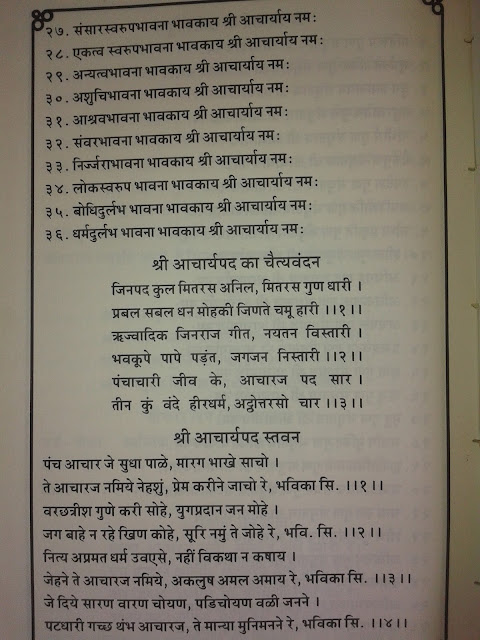
Acharya Pad - Chaityavandan, Stavan and Stuti Vidhi
SIDDHACHAKRA - ACHARYA PAD PRADAKSHINA
SIDDHACHAKRA - ACHARYA PAD 36 KHAMASANA
SIDDHACHAKRA - ACHARYA PAD CHAITYAVANDAN AND STUTI
SIDDHACHAKRA - ACHARYA PAD STUTI
Day 4 - Upadhyaya Pad (Shukla Dasami)
Upadhyaya Pad is the fourth post in Navpad, placed in the lower side
of Arihant in Siddhachakra Yantra. He is the second among Guru Tatva. He is supposed
to know all Jain Agams - eleven Anga and fourteen Purva (twenty five in all). These
are his twenty five attributes. He is responsible for academic activities in the Sangha.
He preaches and teaches Monks and Nuns. He is like a lieutenant and minister of Acharya.
Some sacred Jain scriptures describe him as a Prince in the kingdom of Acharya.
Upadhyaya is symbolized by the color green. Jain followers worship
Upadhyaya Pada on the fourth day and perform Ayambil by eating boiled
Mung only (green - matching Upadhyaya's color).
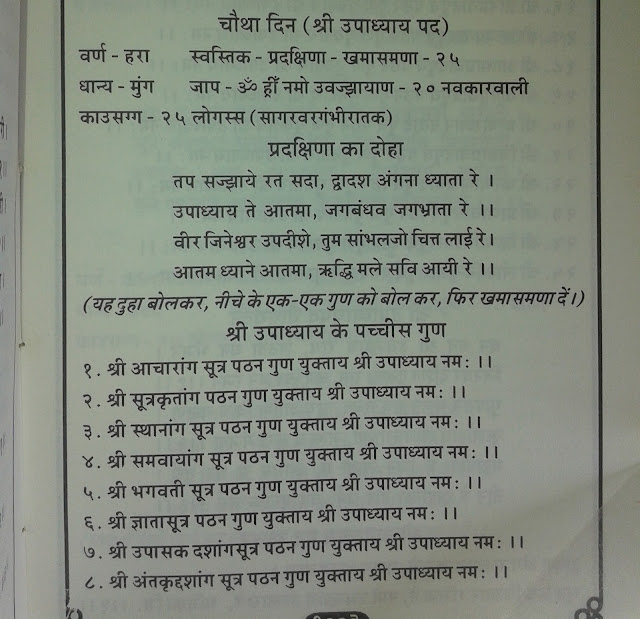
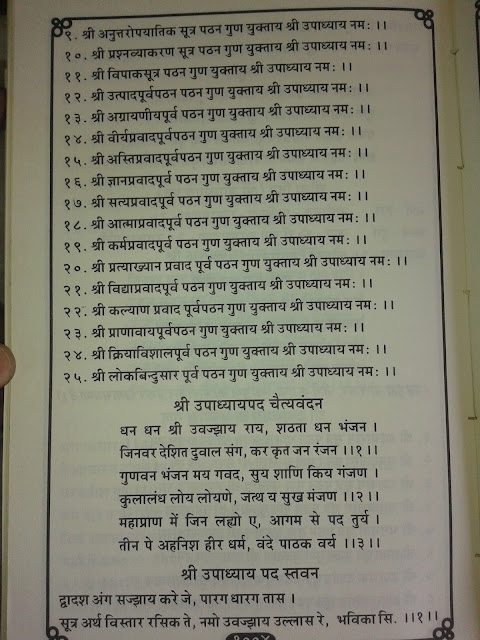
Upadhyaya Pad - Chaityavandan, Stavan and Stuti Vidhi
SIDDHACHAKRA - UPADHYAYA PAD KHAMASANA AND PRADAKSHINA
SIDDHACHAKRA - UPADHYAYA PAD CHAITYAVANDAN AND STAVAN
SIDDHACHAKRA - UPADHYAYA PAD STUTI
Day 5 - Sadhu Pad (Shukla Ekadashi)
Sadhu Pad is the fifth post in Navpad, placed in the left side of
Arihant in Siddhachakra Yantra. He is the third among Guru Tatva. He has renounced
household life and devoted himself to the holy path preached by Arihant and disciplined
by Acharya. He devotes himself for the noble path that leads to salvation and practices
four sacred virtues.
He has five supreme vows - completely abstaining from:
Violence
Lying
Stealing
Sexual conduct
Possessions of earthly things
He practices living in equilibrium in all conditions. He walks bare foot and uses no
vehicles. He does not cook for himself or others and lives on food provided by
households. He does not keep money or earthly assets. He practices austerity and
penance to his optimum capacity under the discipline of Acharya and Upadhyaya. He
has twenty seven attributes and is symbolized by the color black.
Jain followers worship Sadhu Pada on the fifth day. They perform Ayambil by eating
boiled Udad only (black - matching Sadhu's color).
SIDDHACHAKRA - SADHU PAD KHAMASANA AND PRADAKSHINA
SIDDHACHAKRA - SADHU PAD KHAMASANA
SIDDHACHAKRA - SADHU PAD CHAITYAVANDAN STAVAN AND STUTI
Day 6 - Samyag Darshan Pad (Shukla Dwadashi)
Samyag Darshan - Samyag is a Sanskrit word meaning "right" and
Darshan means "view." Hence Samyag Darshan means Right View. It is also described as
faith in the preachings of Arihant. This is the sixth Pad of Siddhachakra and first
of Dharma Tatva. This is the root of all Dharma (Spirituality). Dharma starts with
the right view and perspective. All knowledge is like ignorance without Samyag Darshan.
This is the first among Ratna Trayee (Three Gems) of Jainism to
attain salvation. It has sixty seven attributes and symbolizes with white color.
Jain followers worship Samyag Darshan Pada on the sixth day. They perform Ayambil by
eating boiled rice only (white color).
SAMYAG DARSHAN - RIGHT FAITH AND VISION
Pravachan Audio - Day 6 Samyag Darshan Pad
Day 6 - Samyag Darshan Pad Pravachan by Jain Acharya
Darshan Pad - Chaityavandan, Stavan and Stuti Vidhi
SIDDHACHAKRA - DARSHAN PAD KHAMASANA AND PRADAKSHINA
SIDDHACHAKRA - DARSHAN PAD 67 KHAMASANA AND PRADAKSHINA
SIDDHACHAKRA - DARSHAN PAD KHAMASANA
SIDDHACHAKRA - DARSHAN PAD KHAMASANA AND CHAITYAVANDAN
SIDDHACHAKRA - DARSHAN PAD PRADAKSHINA
Day 7 - Samyag Jnyana Pad (Shukla Trayodashi)
Samyag Jnyana - Jnyana (Gyana) means knowledge. Hence Samyag Jnyana
refers to Right Knowledge, also called wisdom. This is the seventh Pad of Siddhachakra
and second of Dharma Tatva. All actions should be preceded by right knowledge. One
cannot discriminate between right and wrong without right knowledge.
This is the second among Ratna Trayee (Three Gems) of Jainism to
attain salvation. It has five sub-divisions and fifty one attributes and symbolizes
with white color.
Jain followers worship Samyag Jnyana Pada on the seventh day. They perform Ayambil by
eating boiled rice only (white color).
SIDDHACHAKRA - GYAN PAD KHAMASANA AND CHAITYAVANDAN
Day 8 - Samyag Charitra Pad (Shukla Chaturdashi)
Samyag Charitra - Charitra means action or conduct. Hence Samyag
Charitra refers to Right Action or Right Conduct. This is the eighth Pad of
Siddhachakra and third of Dharma Tatva.
This is the third among Ratna Trayee (Three Gems) of Jainism to
attain salvation. It has seventy attributes and symbolizes with white color.
Jain followers worship Samyag Charitra Pada on the eighth day. They perform Ayambil
by eating boiled rice only (white color).
SAMYAG CHARITRA - RIGHT CONDUCT
Pravachan Audio - Day 8 Samyag Charitra Pad
Day 8 - Samyag Charitra Pad Pravachan by Jain Acharya
Charitra Pad - Chaityavandan, Stavan and Stuti Vidhi
CHARITRA PAD
CHARITRA PAD - KHAMASANA
CHARITRA PAD
CHARITRA PAD
Day 9 - Samyag Tapa Pad (Shukla Purnima - Final Day)
Samyag Tapa - Tapa means austerity or penance. Samyag Tap means
austerity in the right perspective and direction. It is the last Pad of Navapad. Jain
holy scriptures describe Tap as abstaining from lusts and desires. The goal of
austerity is reaching equilibrium and tranquility.
There are two types of austerity - internal and external,
each further classified into six types. Fast and penance are among externals. Modesty,
nursing and meditation are among the internals. Observing internal austerity is more
valuable than externals. It has fifty attributes and symbolizes with
white color.
Jain households, Monks and Nuns worship Samyag Tapa Pada on the ninth and final day
of Navapad Oli. They perform Ayambil by eating boiled rice only
(white color).