Showing posts with label JAIN SYMBOL. Show all posts

Saturday, April 6, 2013

JAIN STAVAN: LIFE OF MAHAVIR SWAMI: KATHA SU AAYO HIRO

JAIN STAVAN: LIFE OF MAHAVIR SWAMI: KATHA SU AAYO HIRO


JAI JINENDRA,
THIS STAVAN IS ABOUT THE LIFE OF MAHAVIR SWAMI AND THE PANCH (FIVE) KALYANAKS WHICH HAPPEN IN EACH AND EVERY TIRTHANKAR'S LIFE.
ALSO VARIOUS EVENTS OF MAHAVIR SWAMI'S LIFE ARE ALSO SHOWN IN THIS STAVAN.

Panch mean -five and Kalyanak mean -for the betterment of all living beings.


1) Garbha-Kalyanak or Inception ceremony:
·         Six months before the inception & during the nine months of pregnancy Indra Kuber showers precious jewels in the city.
·         Saudharm Indra assembles his cabinet & celebrates the joyous day.
·         Eight young girls celebrate the day with the mother with music & dances.
·         Garbha Kalyanak Pooja is done during the day.
·         Mother witnesses 16 dreams this night.
·         In the evening King’s (father) cabinet assembles, the king explains the meaning of all her dreams.
·         56 (DIPKUMARIS)young girls present the mother with the gifts through joyous dances.

2) Janma Kalyanak: Birth ceremony

·         Saudharm Indra celebrates the birth by making three circles of celebration hall.
·         The Birth is celebrated with songs & dances.
·         Sachi Indrani brings the child from the mother & enjoys the presence of child Bhagwan with dances.
·         Saudharm Indra wants to have the child desperately, once Sachi Indrani gives him the child, he enjoys the aura with his thousand eyes & still remains unsatisfied.
·         Saudharm Indra takes the newborn Bhagwan to Mount Meru on Aravat elephant in a large procession.
·         At Mount Meru the Bhagwan’s Abhishek is done with 1008 Kalash
·         Janma Kalyanak Pooja is done during the day.
·         Saudharm Indra celebrates the joyous occasion with Taandav dance to honor Tirthankar’s birth.
·         In the evening everyone enjoys the opportunity of swinging the child God in a magnificent swing created by heavenly Gods.
·         Child God’s birth is celebrated for the spiritual fulfillment, as this is His last birth.


3) Diksha Kalyanak: Renunciation ceremony

·         In the King’s assembly the young prince declares his intention of renouncing the worldly life and the parents accept this decision with joy.
·         Lokantik angles praise the renunciation thoughts of the prince.
·         Procession of the prince to jungle.
·         Discussion between Indras & Kings as to who has the right to carry the Palaki (coach).
·         Process of Aahardaan (first meal after Diksha).
·         Diksha Kalyanak Pooja is performing during the day.
·         Behind the closed doors special processes are done to the statue.

4) Keval Gyan Kalyanak: Omniscience celebration

·         Celebration of Keval Gyan by all, with music & dances.
·         Creation of Samosaran by heavenly Indra.
·         Divya- Dhawni (sermons) and questions by Gandhar’s.
·         Keval Gyan Kalyanak Pooja.
·         Behind the close doors Keval Gyan process is done to all the statues and at this point the doors are opened because after achieving Keval Gyan the statues are now transformed in to Gods.

5): Moksh Kalyanak: Celebration of liberation
·         Declaration of Moksh & celebrations with loud musical instruments & dances.
·         Evaporation of physical body in presence of heavenly Indra Agnikumar.
·         Nirvan Kalyanak Pooja.
·         Shanti havan.

JAINAM JAYATI SHASHNAM.

Sunday, September 23, 2012

JAIN SYMBOLS

Jain Symbols

JAI JINENDRA - GREETING


JAI JINENDRA
JAI JINENDRA

Jai Jinendra literally means, “May the religion
established by the Jina prevail in our hearts”. As we
greet others we say, “Jai Jinendra” because we see an
image of a Jina, destroyer of all inner enemies, in them.
Recognizing this, we bow down with respect to their
Soul. Every Soul is capable of becoming a Jina, the
destroyer of inner enemies; anger, greed, ego, and
deceit. Jina is also known as Arihanta or Tirthankar. We
consider them as Jain Gods.


JINÄLAYA - JAIN TEMPLE(Deräsar or Mandir)


JINALAYA

JINALAYA

A Jinälaya, Deräsar, or Mandir is a
place of worship where a person experiences
immense peace and serenity.
The images of Tirthankars and the
temple’s environment promote introspection and
bring home the feeling that God resides within
one’s own heart. Therefore, each person can
follow a path of purification of the inner self
devoid of anger, greed, ego, deceit, and
attachment from their lives.

OM

OM
OM
Om means completeness. It is a
symbolic word meaning infinite, the perfect,
and the eternal. The very sound is complete,
representing the wholeness of all things.
Upon attaining absolute knowledge or
omniscience, the body of the Arihanta
emanates Om (called the Divine Sound -
Divya Dhwani). It is an involuntary,
spontaneous, and melodious sound that all
humans, animals, and heavenly beings can 
understand as a sermon, in their own language.
Om sounds like Aum, which is the
seat of the five benedictions (salutations of
supreme beings) and is made up of five
sounds and letters: a, a, ä, u, and m:

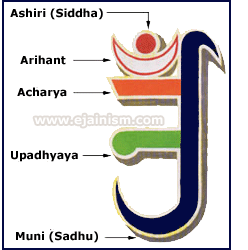
• The first letter “a” represents Arihanta (a human being who has
realized the true nature of the soul and reality and has conquered
passions).
• The second “a” represents Ashariri (Siddha, a liberated soul who does not have a physical body)
• The third letter “ä” represents Ächärya (an ascetic who is head of the Jain congregation).
• The fourth letter “u” represents Upädhyäy (an ascetic teacher).
• The fifth letter “m” represents Muni (Sädhus or Sädhvis who
practice Jain principles).
The Om represents a salutation to the five revered personalities in the Jain religion. Om is a shortened form of the Namokär Mantra.

HRIM

HRIM
HRIM
The word Hrim is a seed mantra. It is called
Hrimkär mantra.
It is a mystical symbol representing the invisible
sound, infinity, and divine energy of the 24 Tirthankars.
While meditating on Hrim, one can experience the
sublimating energy of Tirthankars.


ARHAM 

ARHUM

ARHAM


The word ARHAM is a mantra
representing all vowel and consonant
sounds used in the Sanskrut alphabet. The
first vowel in the Sanskrut alphabet is “a” and
the last consonant is “h.” Therefore, while
meditating on this mantra, one focuses on the
silent sound of the universe

SWASTIKA

SWASTIKA

SWASTIKA


The Swastika is considered an auspicious and a pious
symbol. The red arms of the swastika represent the four
possible states (gatis) of rebirth: human, heaven, hell, and
animal. These four states are represented clockwise starting
from the upper left corner on the Swastika. Our aim should
be liberation from these four states of rebirth.
The three green dots above the swastika represent the three
jewels of Jainism – Samyak Darshan, Samyak Jnän and Samyak
Chäritra. This represents the Jain path of liberation.
At the very top there is a small yellow crescent called
Siddhashilä, a place for liberated souls. The yellow dot above
the crescent represents a Siddha or a liberated soul. In
order to achieve this stage, a soul must destroy all attached
karmas. Every living being should strive for this state of
Liberation or Moksha.

UNIVERSAL JAIN SYMBOL

JAIN SYMBOL

JAIN SYMBOL


This universal Jain symbol is a combination of various symbols, each having a deeper meaning. It was adopted during the 2500 Nirvana celebration of Lord Mahävir.

The outline of the symbol is defined as the Universe or Loka. The

Swastika is explained on the previous page. The raised hand means ‘stop’.
The word in the center of the wheel is “Ahimsä,” meaning non-violence. These two symbols remind us to stop for a minute and think twice before starting
any activity. This gives us a chance to analyze our activities to be sure that they will not hurt anyone by thoughts, words and deeds.
The wheel in the hand shows that if we are not careful and ignore these warnings, then just as the wheel goes around, we will repeatedly go through the cycle of birth and death. The text underneath the symbol, “Parasparopagraho Jivänäm” translates to “Living Beings (souls) Render Service to One Another”

ÄRATI

ÄRATI
ÄRATI

The Ärati has 5 lamps. The flame is lit on a cotton
wick soaked in oil. The Ärati is waved in a circular motion
in front of a Tirthankar idol at the end of a ritual ceremony
and also at night before the temple closes. The darkness
symbolizes negativity, fear, and ignorance, whereas the light
symbolizes divinity. The light of the Ärati dispels darkness,
signifying the overcoming of negativity through virtue, fear
through courage, and ignorance through knowledge.


The 5 lamps symbolize:
• Panch Parmesthi
- Arihanta, Siddha, Ächärya, Upädhyäy, Sädhu
• Five types of jnäns or knowledge
- Matijnän, Shrutjnän, Avadhijnän, Manah Paryäyjnän, Kevaljnän
• Five great vows
- Ahimsä, Non-stealing, Truthfulness,Celibacy, Non-possesion


MANGAL DEEVO

MANGAL DEEVO
MANGAL DEEVO
Mangal deevo has a single wick lamp that is
lit and waved in a circular motion right after the Ärati.
The flame is lit on a cotton wick soaked in oil.
When the wick is lit, it illuminates the face of the
Jina. In this manner, we wish that it would illuminate
our hearts with truth and compassion.
The single lamp is also a symbol of kevaljnän
(infinite knowledge) and liberated souls.

JAIN FLAG

JAIN FLAG

JAIN FLAG

The Jains flag have five different colors.

Red color represents Siddha
Yellow color represents Acharya
White color represents Arihanta
Green color represents Upadhyaya
Dark Blue (or Black) color represents Muni (Sadhu)
There is a symbol of swastik in the central strip.