Showing posts with label NAVKAR MANTRA. Show all posts

Sunday, October 25, 2020

Dwadash Ang sajjay kare Siddhachakra pad vando

|| Bhavika Siddhachakra pad vando ||

सिद्धचक्र पद वंदो  जैन स्तवन

Siddhachakra pad vando JAIN STAVAN SONG ||

 To download this song click HERE


This Blog is sponsored by :

मातुश्री पवनिदेवी अमीचंदजी खाटेड़ संघवी || राजस्थान : करडा
MATUSHREE PAVANIDEVI AMICHANDJI KHATED SANGHVI 


To download Jain Videos click on the Below Links
Click HERE
JAINAM JAYATI SHASHNAM
IF YOU ARE INTERESTED IN LIST OF ALL THE SONGS TO DOWNLOAD  
JUST CLICK THE BELOW HIGHLIGHTED BUTTON TO DOWNLOAD FROM GOOGLE DRIVE
Note : Click HERE to download from google drive and click on the song or down arrow 
to download it

Saturday, November 8, 2014

What is Religion ? : What is Dharma : धर्म क्या हैं

 Dharma : What is Religion ?
Jain Verse:
·       May the entire universe attain bliss,
·       May all beings be oriented to the interest of others,
·       Let all faults be eliminated and
·       May people be happy everywhere.


1  Introduction
Every living being desires happiness, and endeavors to avoid pain and suffering.  The question is how these objectives can be achieved. Generally, a person will feel happy if he gets whatever he desires and can avoid everything that he does not like. However, situations do occur, which are not in his interest or do not conform to his liking.  Even in favorable situations, it is not always within his power to prolong the situation. Every situation changes and a person feels miserable when the new situation is not to his liking. Moreover, desires and likes or dislikes of all beings are not identical. What one person loves may be of utter distaste to another.  It is therefore impossible that everything can happen to everyone’s taste.  Viewed in this light, it would seem that there couldn’t possibly be a way for making everyone happy.

Fortunately, however, there is a way.  Two verses, one each from Jain and Hindu traditions quoted above, address that way.  It should be noted that they have identical meanings. Both of them convey the same message of well-being for all, for the whole universe, and for the elimination of evil. Shraman (Jain, Buddhist) and Vedic (Hindu) traditions have flourished together; both have borrowed from and influenced ideologies of the other.  It is therefore not surprising that Jain scholars have time and again insisted on the study of not only Jainism, but also the six schools of thought prevalent in India and collectively known as Shad-darshan. Broadly classified, they are known as Vedic and Shraman traditions, both having originated from the same Indo-Aryan culture. Both of them have addressed the subject of universal happiness and have discovered that the way to universal happiness is to wish and act for happiness and well-being for all. If everyone acts accordingly, the world can turn into paradise and there would not be any misery; at least man-made misery would come to an end.

Indian philosophies go beyond seeking happiness in this life. Almost all of them believe in the existence of an eternal soul and in a continually changing pattern of everything else. Therefore, they seek happiness that lasts beyond the present life. Their ultimate goal is to present the path of liberation leading to the termination of the cycle of life and death.  However, as long as we are not liberated, their approach is to seek continuing universal happiness. The above two verses therefore urge everyone to look earnestly for the well-being of all others, to stay meritorious in this life to be sure of reaping fruits of their merits in subsequent lives.
When one talks of religion, the question may arise, ‘Why do we bother about religion? Could we not be happy in this life without worrying about religion?’ One may be healthy, have a loving spouse and children that they love, have plenty of money, and possess all the amenities that one needs. What more is religion going to offer?

These are legitimate questions. The concept underlying these questions revolves around our body.  Its health, its relations, its well-being, and comforts and luxuries it can indulge in are supposed to bring forth happiness. Accordingly, when such situations are to our liking, we consider ourselves happy.  Unfortunately the body with which, we identify ourselves and also everything around it is transitory.  All the situations are ephemeral. The happiness that we might be experiencing from such situations can disappear at any time. We do not know what is going to happen at the next moment. In fact, our so-called happiness is unstable and short-lived.
Even if situations conducive to our interest were likely to continue indefinitely, peace and happiness may not always materialize. As the poet Percy Shelley put it in one of his poems, we are prone to ‘look before and after and pine for what is naught.’ Hardly anyone feels satisfied with what he has. We have the tendency to desire what we don’t have. Our desires are endless and as long as those desires remain unsatisfied, no one can ever feel happy and experience real peace that can lead to blissful pleasure. We may strive hard for achieving that pleasure but hardly any one attains it any time during his life.

2  What is Religion?

The growth of scientific knowledge and technology has given new dimensions to our lives and has influenced every aspect of our living. Science has done a great service to mankind by providing amenities for pleasant living and has saved men from many miseries and uncertainties of the primitive past. It has also destroyed many superstitions and religious dogmas. At the same time, the scientific outlook has uprooted the moral, religious, and cultural values of our society. In the light of the advance of scientific perspective some individuals have renounced our traditional religious beliefs and values. We know much about the atom but not much about the values needed for a meaningful and peaceful life. We are living in a state of disarray. Our lives are full of worries, emotional disorders, and conflict of values.
Today man needs mental peace and complete integration with his own personality and with his social environment. Can religion, in general, and Jainism, in particular, meet this need of our times? Yes, it can. Religion has eternal concepts and values that can meet the needs of the time.
Now, what do we mean by the term religion? Many western scholars define religion as faith. Some say that religion is belief in spiritual beings. Others define religion as faith in the conservation of values. The inner core of religion is faith, but it is the faith in our own existence and our own real nature, belief in some eternal and spiritual values that are essential for the existence and uplift of mankind.  A generally accepted definition of religion is ‘Dhärayati Iti Dharma’ It means that what holds (from falling) is religion. Our remaining in a deluded state constitutes a fall and religion tends to protect us. It teaches us that the physical body, with which we identify ourselves, is alive on account of the soul that abides within it. The soul is our true self. We are the consciousness pervading the body and our association with a body terminates at the end of life. The true nature of consciousness is to know whatever happens without any sense of craving or aversion. It is therefore futile to be pleased or displeased with different situations.  Thus by revealing our true nature, religion helps in extricating us from the deluded state in which we have been entangled since time without beginning. Religion teaches us to know ourselves.
“He, who knows one (soul), also knows all; He who knows all, knows the one.”
This quotation taken from Jain scripture Ächäränga Sutra states that he who knows the soul, knows everything else. This is so because the knowledge of true Self as pure, enlightened, not aging, immortal and ever blissful soul can lead to the state of having no desire.
Therefore, Jain scriptures define religion as ‘Vatthu Sahävo Dhammo’. It means that religion is the real nature of things. Religion is the nature or property of all substances (Dravyas) including soul and matter. We seldom try to explore who we are and what is our true nature. Nothing against our nature is going to give us lasting happiness or real satisfaction.  Without knowing ourselves and without realizing our own nature, we have been trying to gain happiness. No wonder that it eludes us, because we have been trying to gain it from extraneous circumstances. In a way, we have been dwelling all the time in a state of delusion about ourselves.  We can just as well say we have been pursuing a mirage.
That being so, what is the real nature of the human being? The real nature of human beings is equanimity. Ächäränga sutra defines religion as mental equanimity. In Bhagavati sutra, Gautam Swami asks Bhagawän Mahävir, "What is the nature of soul?" Bhagawän replies, "The nature of soul is equanimity." Gautam asks, "What is the ultimate aim of soul?" Mahävir replies, "The ultimate aim of the soul is also equanimity." Ächärya Kund-kund, in Samaysär, has equated the essential nature (Svabhäv) of soul with equanimity.
This, of course, does not mean that we should not try to change an undesirable situation; nor does it endorse inaction. As long as the soul is embodied, it will stay active. There are different types of activities that a monk or a laymen should undertake.  Religion, however, prescribes that everyone should undertake activities vigorously but without any degree of attachment. This would mean facing any situation dispassionately without reacting in terms of craving or aversion. The common objective is to enable one to view every situation, comfortable or uncomfortable, with equanimity and without getting agitated. That would amount to knowing oneself and abiding in one’s own blissful nature.
Religion is nothing but an endeavor for the realization of one's own essential nature. Dwelling in one's own essential nature means to remain secure in the state of a spectator or observer. It is the state of subjectivity or of a pure knower. In this state, the consciousness is completely free from excitement and emotions, and the mind becomes tranquil. It is the precondition for enjoying spiritual happiness, and for relieving mental tension, which is an impure state of mind. This is the practice of equanimity of mind. Nobody wants to live in a state of stress. All seek relaxation instead of tension, contentment instead of anxiety. Our real nature is mental peace or equanimity. Religion is nothing but a way of achieving this mental peace.
Religion is truth.  When you first discover and then begin to live by inner truth, it becomes your measurement for everything.  If an action fits with this truth, then you do it.  If it does not, you reject it.  It is not justifying; it is acting in accordance with your inner measuring rod.  Truth becomes your permanent inner companion.
The path to liberation of rational knowledge, rational perception, and rational conduct is the application of equanimity in the three aspects of our conscious life, that is, knowing, feeling and willing. Even-mindedness, broader and unbiased outlook and regard for other ideologies and thoughts constitute equanimity of knowledge or rational knowledge. Detachment from the objects of worldly pleasures, balanced state of mind, and the feeling of equality constitute equanimity of feeling or rational perception. Control over one's desires, regard for other's life and property, equity and fairness in social life constitute equanimity of willing or rational conduct. The three organs of rational conduct are body, speech, and mind. According to Jain teachers, equanimity of body, speech, and mind should be the directive principle of religious life. Equanimity of mind entails non-attachment or non-possessiveness, Equanimity of body is nonviolence (Ahimsa) and Equanimity of speech is non-absolutism. Nonviolence, non-attachment, and non-absolutism are the three pillars of Jainism. By adopting these concepts, we can attain happiness and peace in our lives and create an atmosphere of tolerance and trust in society.

3  Meaning of Jainism


Jainism is a religion propounded by a `Jina'.  Principles enunciated by a `Jina' constitute Jainism and the follower of Jainism is known as a `Jain'.  Further, a `Jina' is neither a supernatural being nor an incarnation of an all powerful God.  The word `Jina' means the conqueror or the victorious, i. e., one who has conquered the worldly passions by one's own strenuous efforts.  Human beings are entitled to become `Jinas' and as such `Jinas' are persons of this world who have attained supreme knowledge, subjugated their passions like desire, hatred, anger, greed, and pride and are free from any sort of attachment.  Thus, Jainism is a religion of purely human origin. It is propogated by self-realized individuals who have attained perfect knowledge, omniscience, and self-control by personal effort and have been liberated from the bonds of worldly existence, and the cycles of all future life and death. Jinas are popularly viewed as Gods in Jainism. There are an infinite number of Jinas existed in the past. All human beings have the potential to become a Jina.
In ancient times, Jainism was also known by Shraman Dharma, an ascetic tradition or the religion of Nirgrantha, one who is not attached to internal or external objects.
The basic tenet of Jainism is "Ahimsa Parmo Dharmah".  From an ethical point of view Dharma means duty - compassion is the supreme duty of an individual.  From a religious point of view, Dharma means the true nature of a substance - compassion is the true nature of a human being.  Also, the Jain dictum "Parasparopagraho Jivänäm" means, "Living beings (Souls) render service to one another".

4  Why Do We Pray?

A Jain verse says, “I bow down to the path of salvation, which is supreme, which is omniscient; I bow down to that power because I wish to become like that power.” The object is not to receive anything from the entity or from that spiritual nature, but to become one like that.Its not that spiritual entity will make usbecome like itself by a magic power, but by following out of ideal which is before our eyes, we shall be able to change our own personality.It will be regenerated, as it were, and will be changed into a being, which will have the same character and divinity which is our idea of God.  So we worship God, not as a being who is going to give us something, not because it is going to do something to please us, not because it is profitable in any way; there is not any idea of selfishness; it is like practicing virtue for the sake of virtue and without any other motive.
God to us would mean to have attained the perfect and liberated state.  We pay homage to the perfect for the sake to perfection, and not for any reward.  One of the prayers of the Jaina is “I worship with power all consciousness which becomes the leader for us on the path of salvation; which has broken to pieces the mountain of physical forces of Karma; which has acquired omniscience.  ” I worship it because I wish to become that power.
The Jinas are not Gods in the sense of being the creators of the universe, but rather as those who have accomplished the ultimate goal of liberation through the true understanding of self and other realities.  The concept of God as a creator, protector, and destroyer of the universe does not exist in Jainism.  The concept of God's descent into a human form to destroy evil is also not applicable in Jainism.
The Jinas that have established the religious order and revived the Jain philosophy at various times in the history of mankind are known as Tirthankars. The ascetic sage, Rishabhadev was the first Tirthankar and Mahävir was the last Tirthankar of the spiritual lineage of the twenty-four Tirthankars in the current era.

In summary, Jainism does not believe in a creator God, however this does not mean that Jainism is an atheistic religion.  Jains believe in an infinite number of Jinas (Gods) who are self-realized omniscient individuals who have attained liberation from birth, death, and suffering.

Note : This content has been taken from "Jain Education Bowl".

Wednesday, July 24, 2013

EXPLANATION \ MEANING OF NAVKAR MAHA MANTRA (PRATIKRAMANA SUTRA)

Sunday, April 21, 2013

NAVPAD OLI AYAMBIL IN JAINISM : नवपद आयम्बिल ओली :NAVAPAD AYAMBIL OOLI: JAIN FESTIVAL :NAVPAD ARADHANA PRAVACHANS

Navpad Oli (Ayambil) - Jain Festival
|| Navapad Ayambil Oli || नवपद आयम्बिल ओली ||
Siddhachakra Tap - Navpad Pravachan

Let us first listen to Navkar Mahamantra / Namaskar Mahamantra to begin

The virtues of the Siddha Chakra are so many, we cannot describe them.
They fulfil the desires of the worshipper.
We pray to them a thousand times.

About Navpad Oli - Jain Festival

Navpad and Navapad Oli holds great significance in Jainism. It is one of the most important religious festivals of the Jain community. Navpad Oli comes twice a year - in Chaitra (March/April) and Ashwin (September/October). Devotees observe Ayambil Tap during the nine days of Navpad Oli.

The festival falls exactly between Shukla Saptami (Seventh lunar day) and Purnima (Full moon day) in both Ashwina and Chaitra months. Navapad Oli starts in the middle of Navratri. Both Navapad Olis fall among the five Shaswata Atthai of Jain. The remaining three Atthai are Chaturmasik Atthai (observed thrice a year).

Jains perform Ayambil Tapa for nine days to salute the nine supreme posts in the universe. Ayambil is a special type of fast in which one eats only boiled grains once a day. It is not permitted to add anything - including salt - to the boiled grains. Hence it is considered very difficult for a layman to perform Ayambil Tap.

The earth's day and night are almost equal during March-April and September-October - the seasons of Navapad Oli. These are moderate seasons perfectly suitable for worshipping the supreme powers of the universe. Devotion and Navpad prayer keeps us mentally healthy, whereas Ayambil and penance energizes us physically.

Nava means nine in Sanskrit and Prakrit languages and Pada means post. Hence Navapada means nine supreme posts of the universe.

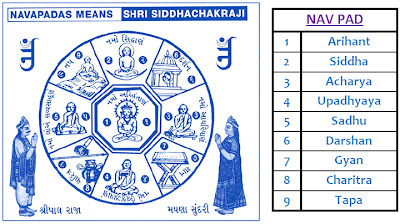
These nine are: ARIHANT, SIDDHA, ACHARYA, UPADHYAYA, SADHU, SAMYAG DARSHAN, SAMYAG GYAN, SAMYAG CHARITRA and SAMYAG TAPA.

Navapad is also called SIDDHA CHAKRA.

Siddhachakra Yantra - Sacred Jain diagram with 9 Pads of Navapad

SIDDHA CHAKRA YANTRA

Panch Parmeshti - Five Supreme Beings in Jainism - Arihant Siddha Acharya Upadhyaya Sadhu

PANCH PARMESHTI PAD

Siddhachakra Mahayantra - Complete sacred Jain diagram with all 9 Navapad positions

SIDDHACHAKRA MAHAYANTRA - Explanation of Design

Jain devotees performing Samuh Ayambil Tap together during Navapad Oli festival

NAVAPAD - Community Ayambil

Speciality of Navapad

The first five posts of Navapad are called Panch Parameshthi, where Param means ultimate or supreme and Esthi means to worship. These five are the eternal powers to be worshipped.

Arihant and Siddha are Deva Tatva (God Principle). Acharya, Upadhyaya and Sadhu are Guru Tatva (Preacher Principle). The last four Pads of Navapad are great virtues depicted as Dharma Tatva (Spirituality Principle) in Jainism. One can attain Moksha (salvation) by observing those virtues. Arihant and Siddha - the first two posts - have accomplished these four virtues. Acharya, Upadhyaya and Sadhu are on the path of accomplishing them.

The Siddhachakra is a Yantra in circular shape. Siddha is placed at the top. Arihant is in the center. Acharya is at the right side of Arihant. Upadhyaya is in the lower side and Sadhu in the left side. Samyag Darshan, Samyag Jnyan, Samyag Charitra and Samyag Tapa are placed in four corners starting from upper right and moving clockwise.

Generally the first five (Panch Parameshthi) are placed in the form of idols and the next four by name only.

Ritual of the Navpad Oli - Daily Worship Numbers

No. Name of the Pad Kayotsarga (Logassa) Khamasanas Swastiks Navkarvalis
1. Aum Rhim Namo Arihantanam 12121220
2. Aum Rhim Namo Siddhanam 08080820
3. Aum Rhim Namo Aayariyanam 36363620
4. Aum Rhim Namo Uvajzayanam 25252520
5. Aum Rhim Namo Loe Savva Sahunam 27272720
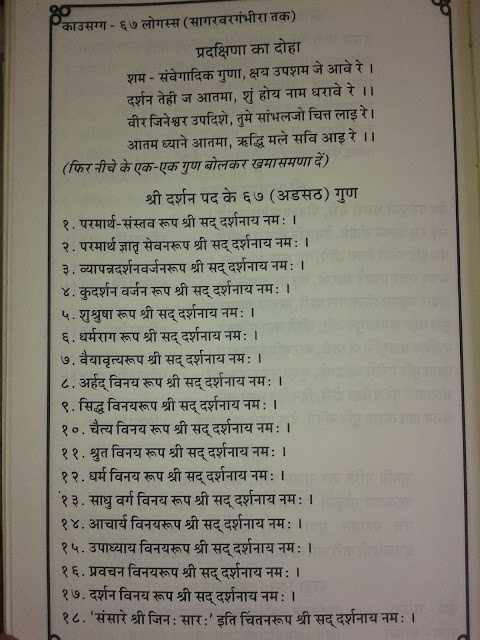
6. Aum Rhim Namo Dansanassa 67676720
7. Aum Rhim Namo Nanassa 51515120
8. Aum Rhim Namo Charittassa 70707020
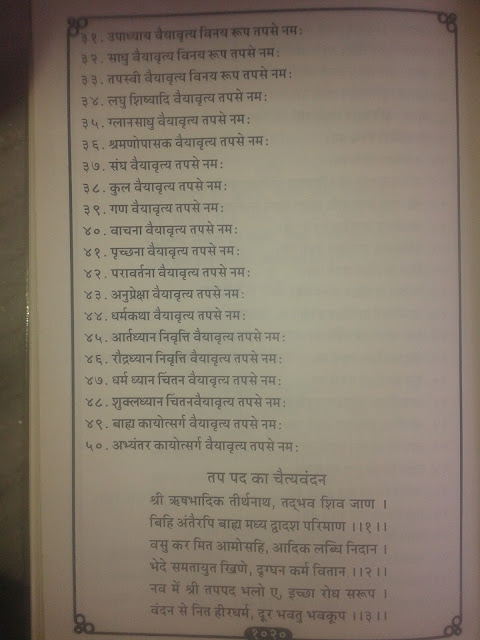
9. Aum Rhim Namo Tavvasa 50505020

Inspiring Pravachans on Each Pad - by Jain Acharya

Below are inspiring pravachans on each Pad by Jain Acharya.

Day 1 - Arihant Pad (Shukla Saptami)

Arihant Pad is the first post of Navapad, placed in the center of Siddhachakra Yantra. It falls among Deva Tatva. Arihant is the supreme power of nature - the purest soul in the universe with a physical body. Ari means enemy and Hant means destroyer. The enemies here are internal - Raga (craving/attachment) and Dvesha (hatred). Hence Arihant is free from earthly attachments and referred to as Veetraga.

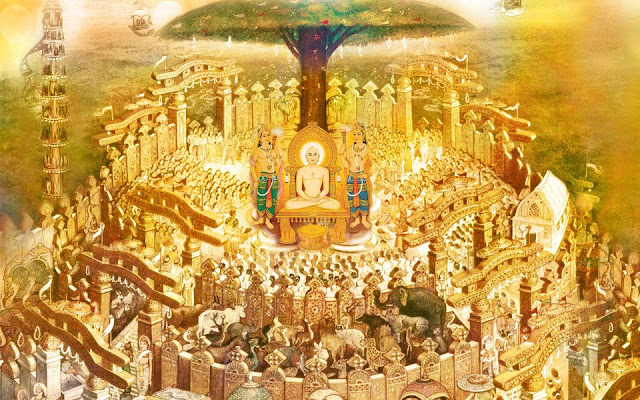
Arihant has complete wisdom - Kevala Jnyana. He preaches true spirituality in a Samavasharan and establishes the Chaturvidha Sangha - Sadhu (Monks), Sadhwi (Nuns), Shravaka (Household followers, Male) and Shravika (Household followers, Female). Because he establishes the Teertha, he is also called Tirthankar. He has twelve supreme attributes and is symbolized by the color white.

Jain followers worship Arihant Pada on the first day of Navapad Oli. They perform Ayambil by eating boiled rice only (white - matching Arihant's color).

Lord Mahavir - 24th Tirthankara of Jainism - Arihant Pad Navpad Oli

ARIHANT PAD - Lord Mahavir Swami

Pravachan Audio - Day 1 Arihant Pad

Day 1 - Arihant Pad Pravachan by Jain Acharya


Download - Day 1 Arihant Pravachan

Arihant Pad - Chaityavandan, Stavan and Stuti Vidhi

Shree Navpad Oli Vidhi - Arihant Pad Day 1 Chaityavandan Stavan and Stuti guide

SHREE NAVPAD OLI VIDHI - ARIHANT PAD

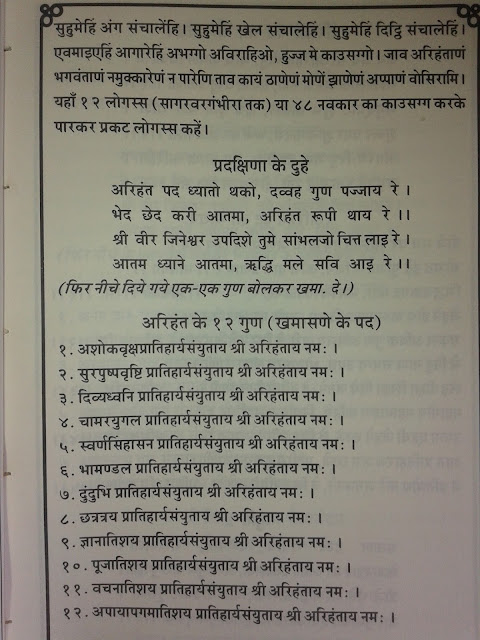
Arihant Pad 12 Khamasana and Pradakshina - Navpad Oli Siddhachakra Vidhi

ARIHANT PAD - 12 KHAMASANA AND PRADAKSHINA

Siddhachakra Arihant Pad Chaityavandan Stavan and Stuti ceremony photo

SIDDHACHAKRA - ARIHANT PAD CHAITYAVANDAN STAVAN AND STUTI

Day 2 - Siddha Pad (Shukla Astami)

Siddha Pad is the second post of Navapad, placed at the top of Siddhachakra Yantra. It is also Deva Tatva. Siddha is the supreme power of nature - the purest soul in the universe without a physical body. One becomes Siddha after attaining salvation. The Siddha is a Veetraga and universal observer but does not preach as he has no physical body. He lives in perfect equilibrium, eternal peace and joy and remains in perfect motionless rest.

Siddha is free from all Karmic bondage, hence there is no reincarnation. He lives forever above the Siddha Shila at the top of the Universe. He has eight supreme attributes and is symbolized by the color red.

Jain followers worship Siddha Pada on the second day. They perform Ayambil by eating boiled wheat only (red - matching Siddha's color).

Siddha Shila - Abode of liberated souls in Jain cosmology above the universe

SIDDHA PAD - SIDDHA SHILA

Pravachan Audio - Day 2 Siddha Pad

Day 2 - Siddha Pad Pravachan by Jain Acharya


Download - Day 2 Siddha Pravachan

Siddha Pad - Chaityavandan, Stavan and Stuti Vidhi

Siddha Pad Khamasana and Pradakshina during Navpad Oli Siddhachakra ceremony

SIDDHA PAD - KHAMASANA AND PRADAKSHINA

Siddhachakra Siddha Pad Stuti and Stavan text for Navpad Oli Chaityavandan

SIDDHACHAKRA - SIDDHA PAD CHAITYAVANDAN STAVAN AND STUTI

Day 3 - Acharya Pad (Shukla Navami)

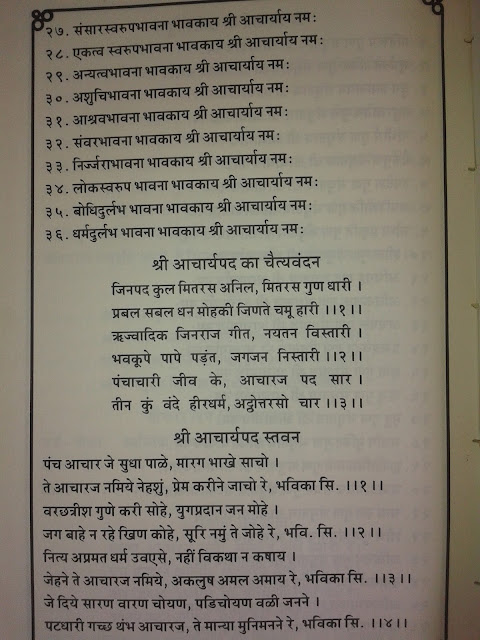
Acharya Pad is the third post in Navpad, placed at the right side of Arihant in Siddhachakra Yantra. He is the first among Guru Tatva. Acharya is the successor of Arihant and leader of the fourfold Sangh. He is the Supremo and ultimate decision-making authority in all Sangha matters in the absence of Arihant. He is also the ultimate authority in interpretation of the Jain Agam (Holy Scriptures).

He observes and motivates Monks and Nuns for five spiritual conducts - Jnyanachara, Darshanachara, Charitrachara, Tapachara and Veeryachara. The first four relate to the last four Padas of Siddhachakra. Veeryachara is the enthusiasm and power to observe all four. Acharya has thirty six attributes and symbolizes by golden yellow color.

Jain followers worship Acharya Pada on the third day. They perform Ayambil by eating boiled gram only (yellow - matching Acharya's color).

Acharya Pad - Jain Ganadhar - Supreme leader of Chaturvidha Sangha

ACHARYA PAD

Pravachan Audio - Day 3 Acharya Pad

Day 3 - Acharya Pad Pravachan by Jain Acharya


Download - Day 3 Acharya Pravachan

Acharya Pad - Chaityavandan, Stavan and Stuti Vidhi

Siddhachakra Acharya Pad Pradakshina and worship during Navpad Oli

SIDDHACHAKRA - ACHARYA PAD PRADAKSHINA

Acharya Pad 36 Khamasana devotees during Navpad Oli Siddhachakra

SIDDHACHAKRA - ACHARYA PAD 36 KHAMASANA

Acharya Pad Chaityavandan and Stuti ceremony during Navpad Oli

SIDDHACHAKRA - ACHARYA PAD CHAITYAVANDAN AND STUTI

Acharya Pad Stuti text and prayers for Navpad Oli

SIDDHACHAKRA - ACHARYA PAD STUTI

Day 4 - Upadhyaya Pad (Shukla Dasami)

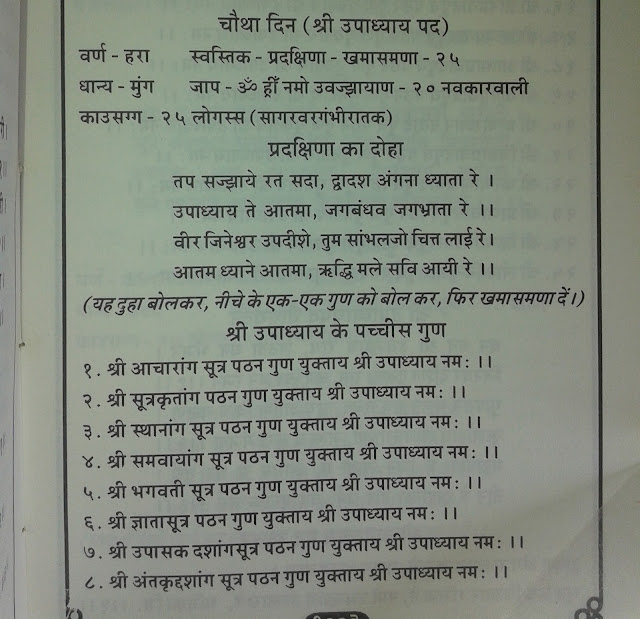
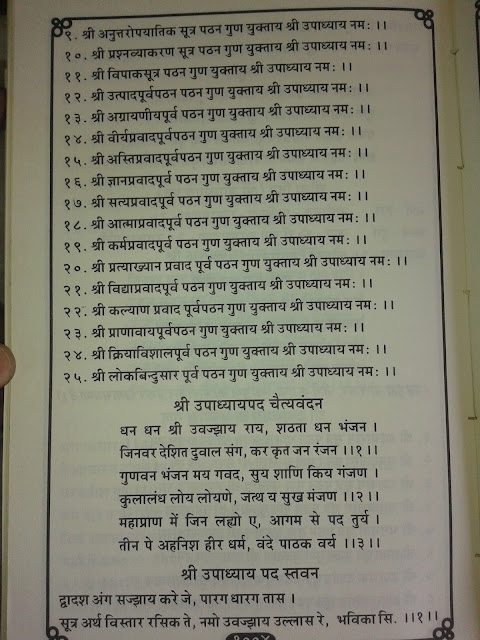
Upadhyaya Pad is the fourth post in Navpad, placed in the lower side of Arihant in Siddhachakra Yantra. He is the second among Guru Tatva. He is supposed to know all Jain Agams - eleven Anga and fourteen Purva (twenty five in all). These are his twenty five attributes. He is responsible for academic activities in the Sangha. He preaches and teaches Monks and Nuns. He is like a lieutenant and minister of Acharya. Some sacred Jain scriptures describe him as a Prince in the kingdom of Acharya.

Upadhyaya is symbolized by the color green. Jain followers worship Upadhyaya Pada on the fourth day and perform Ayambil by eating boiled Mung only (green - matching Upadhyaya's color).

Upadhyaya Pad - Jain teacher of monks and nuns in Chaturvidha Sangha

UPADHYAYA PAD

Pravachan Audio - Day 4 Upadhyaya Pad

Day 4 - Upadhyaya Pad Pravachan by Jain Acharya


Download - Day 4 Upadhyaya Pravachan

Upadhyaya Pad - Chaityavandan, Stavan and Stuti Vidhi

Upadhyaya Pad Khamasana and Pradakshina during Navpad Oli Siddhachakra

SIDDHACHAKRA - UPADHYAYA PAD KHAMASANA AND PRADAKSHINA

Siddhachakra Upadhyaya Pad Chaityavandan and Stavan during Navpad Oli

SIDDHACHAKRA - UPADHYAYA PAD CHAITYAVANDAN AND STAVAN

Upadhyaya Pad Stuti and Chaityavandan text for Navpad Oli

SIDDHACHAKRA - UPADHYAYA PAD STUTI

Day 5 - Sadhu Pad (Shukla Ekadashi)

Sadhu Pad is the fifth post in Navpad, placed in the left side of Arihant in Siddhachakra Yantra. He is the third among Guru Tatva. He has renounced household life and devoted himself to the holy path preached by Arihant and disciplined by Acharya. He devotes himself for the noble path that leads to salvation and practices four sacred virtues.

He has five supreme vows - completely abstaining from:

  1. Violence
  2. Lying
  3. Stealing
  4. Sexual conduct
  5. Possessions of earthly things

He practices living in equilibrium in all conditions. He walks bare foot and uses no vehicles. He does not cook for himself or others and lives on food provided by households. He does not keep money or earthly assets. He practices austerity and penance to his optimum capacity under the discipline of Acharya and Upadhyaya. He has twenty seven attributes and is symbolized by the color black.

Jain followers worship Sadhu Pada on the fifth day. They perform Ayambil by eating boiled Udad only (black - matching Sadhu's color).

Jain Sadhu Monk - renounced worldly life - Sadhu Pad Navpad Oli

SADHU PAD

Pravachan Audio - Day 5 Sadhu Pad

Day 5 - Sadhu Pad Pravachan by Jain Acharya


Download - Day 5 Sadhu Pravachan

Sadhu Pad - Chaityavandan, Stavan and Stuti Vidhi

Sadhu Pad Khamasana and Pradakshina during Navpad Oli Siddhachakra

SIDDHACHAKRA - SADHU PAD KHAMASANA AND PRADAKSHINA

Sadhu Pad Khamasana ceremony photo during Navpad Oli

SIDDHACHAKRA - SADHU PAD KHAMASANA

Sadhu Pad Stuti and Stavan text for Navpad Oli Chaityavandan

SIDDHACHAKRA - SADHU PAD CHAITYAVANDAN STAVAN AND STUTI

Day 6 - Samyag Darshan Pad (Shukla Dwadashi)

Samyag Darshan - Samyag is a Sanskrit word meaning "right" and Darshan means "view." Hence Samyag Darshan means Right View. It is also described as faith in the preachings of Arihant. This is the sixth Pad of Siddhachakra and first of Dharma Tatva. This is the root of all Dharma (Spirituality). Dharma starts with the right view and perspective. All knowledge is like ignorance without Samyag Darshan.

This is the first among Ratna Trayee (Three Gems) of Jainism to attain salvation. It has sixty seven attributes and symbolizes with white color.

Jain followers worship Samyag Darshan Pada on the sixth day. They perform Ayambil by eating boiled rice only (white color).

Jain Temple - Samyag Darshan - Right Faith and Right Vision in Jainism

SAMYAG DARSHAN - RIGHT FAITH AND VISION

Pravachan Audio - Day 6 Samyag Darshan Pad

Day 6 - Samyag Darshan Pad Pravachan by Jain Acharya


Download - Day 6 Samyag Darshan Pravachan

Darshan Pad - Chaityavandan, Stavan and Stuti Vidhi

Darshan Pad Khamasana and Pradakshina during Navpad Oli Siddhachakra

SIDDHACHAKRA - DARSHAN PAD KHAMASANA AND PRADAKSHINA

67 Khamasana of Darshan Pad during Navpad Oli Ayambil ceremony

SIDDHACHAKRA - DARSHAN PAD 67 KHAMASANA AND PRADAKSHINA

Darshan Pad Khamasana prayer during Navpad Oli Siddhachakra

SIDDHACHAKRA - DARSHAN PAD KHAMASANA

Darshan Pad Khamasana and Chaityavandan during Navpad Oli

SIDDHACHAKRA - DARSHAN PAD KHAMASANA AND CHAITYAVANDAN

Darshan Pad Pradakshina during Navpad Oli Siddhachakra ceremony

SIDDHACHAKRA - DARSHAN PAD PRADAKSHINA

Day 7 - Samyag Jnyana Pad (Shukla Trayodashi)

Samyag Jnyana - Jnyana (Gyana) means knowledge. Hence Samyag Jnyana refers to Right Knowledge, also called wisdom. This is the seventh Pad of Siddhachakra and second of Dharma Tatva. All actions should be preceded by right knowledge. One cannot discriminate between right and wrong without right knowledge.

This is the second among Ratna Trayee (Three Gems) of Jainism to attain salvation. It has five sub-divisions and fifty one attributes and symbolizes with white color.

Jain followers worship Samyag Jnyana Pada on the seventh day. They perform Ayambil by eating boiled rice only (white color).

Samyag Gyan - Right Knowledge - second gem of Jain Ratna Trayee

SAMYAG GYAN - RIGHT KNOWLEDGE

Kalpasutra - Mahavira Nirvana illustration - ancient Jain scripture

KALPASUTRA - MAHAVIRA NIRVANA (GYAN)

Pravachan Audio - Day 7 Samyag Gyan Pad

Day 7 - Samyag Gyan Pad Pravachan by Jain Acharya


Download - Day 7 Samyag Gyan Pravachan

Gyan Pad - Chaityavandan, Stavan and Stuti Vidhi

Gyan Pad Khamasana and Pradakshina during Navpad Oli Siddhachakra

SIDDHACHAKRA - GYAN PAD KHAMASANA AND PRADAKSHINA

Gyan Pad Khamasana and Chaityavandan during Navpad Oli

SIDDHACHAKRA - GYAN PAD KHAMASANA AND CHAITYAVANDAN

Day 8 - Samyag Charitra Pad (Shukla Chaturdashi)

Samyag Charitra - Charitra means action or conduct. Hence Samyag Charitra refers to Right Action or Right Conduct. This is the eighth Pad of Siddhachakra and third of Dharma Tatva.

This is the third among Ratna Trayee (Three Gems) of Jainism to attain salvation. It has seventy attributes and symbolizes with white color.

Jain followers worship Samyag Charitra Pada on the eighth day. They perform Ayambil by eating boiled rice only (white color).

Lord Mahavir Swami - Samyag Charitra - Right Conduct third gem of Jainism

SAMYAG CHARITRA - RIGHT CONDUCT

Pravachan Audio - Day 8 Samyag Charitra Pad

Day 8 - Samyag Charitra Pad Pravachan by Jain Acharya


Download - Day 8 Samyag Charitra Pravachan

Charitra Pad - Chaityavandan, Stavan and Stuti Vidhi

Charitra Pad ceremony during Navpad Oli Siddhachakra

CHARITRA PAD

Charitra Pad Khamasana during Navpad Oli ceremony

CHARITRA PAD - KHAMASANA

Charitra Pad Navpad Oli prayer and Pradakshina

CHARITRA PAD

Charitra Pad devotional ceremony during Navpad Oli

CHARITRA PAD

Day 9 - Samyag Tapa Pad (Shukla Purnima - Final Day)

Samyag Tapa - Tapa means austerity or penance. Samyag Tap means austerity in the right perspective and direction. It is the last Pad of Navapad. Jain holy scriptures describe Tap as abstaining from lusts and desires. The goal of austerity is reaching equilibrium and tranquility.

There are two types of austerity - internal and external, each further classified into six types. Fast and penance are among externals. Modesty, nursing and meditation are among the internals. Observing internal austerity is more valuable than externals. It has fifty attributes and symbolizes with white color.

Jain households, Monks and Nuns worship Samyag Tapa Pada on the ninth and final day of Navapad Oli. They perform Ayambil by eating boiled rice only (white color).

Lord Mahavir in meditation - Samyag Tapa - Right Austerity last Pad of Navapad

SAMYAG TAPA - RIGHT AUSTERITY

Pravachan Audio - Day 9 Samyag Tapa Pad

Day 9 - Samyag Tapa Pad Pravachan by Jain Acharya


Download - Day 9 Samyag Tapa Pravachan

Tapa Pad - Chaityavandan, Stavan and Stuti Vidhi

Tap Pad ceremony during Navpad Oli Siddhachakra final day

TAP PAD

Tap Pad Khamasana during Navpad Oli Purnima final day

TAP PAD

Tap Pad prayer and worship during Navpad Oli

TAP PAD

Tap Pad devotional ceremony on Purnima during Navpad Oli final day

TAP PAD

Navkar Mantra - Devotional Songs and Stavan

Siddhagiri Na Shikharo Bole Om Namo Arihantam


Download - Siddhagiri Na Shikharo Bole

Samro Mantra Bhalo Navkar


Download - Samro Mantra Bhalo Navkar

Navkar Mantra Hain Pyara - by Lata


Download - Navkar Mantra Hain Pyara

Mantra Navkar Che Mangalkari


Download - Mantra Navkar Che Mangalkari

Shripal - Maina Sundari Amar Katha

To listen to the Shripal-Maina Sundari Katha, click the link below:

Shripal - Maina Sundari Amar Katha


Download - Shripal-Maina Sundari Katha

Download All Navpad Oli Songs from Google Drive

Click below to access the complete collection of all Navpad Oli songs and pravachans:

Click Here to Download All Songs

Note: Click on the song name or the down-arrow icon inside the folder to download individual files.

Navkar Mahamantra - Closing Prayer

Sab Tapasvi Sukh Shata Main Rahejo
Jainam Jayati Shashnam

Reference: Original post - Jain Festival Navpad Oli by Jyoti Kothari

Saturday, June 30, 2012

NAVKAR MANTRA


                                    II  Navkar Mantr(नवकार मंत्र) II


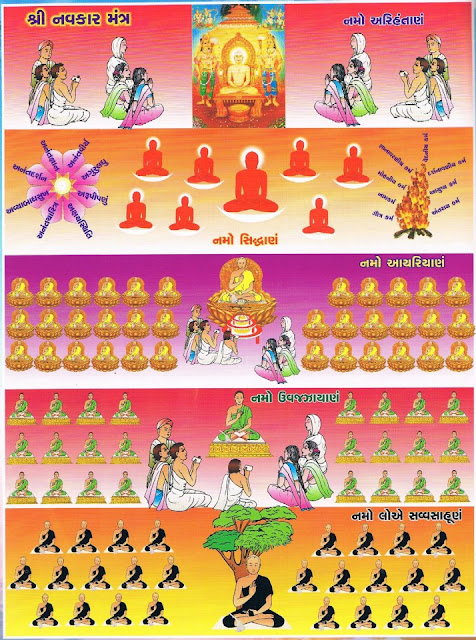
Navkar Mantra is the universal prayer of Jainism. The Navkar Mantra is the most important mantra in Jainism and can be recited at any time. This mantra is also called Namaskar (नमस्कार) or Namokar (णमोकार) Mantra.
While reciting this mantra, the devotee bows with respect to humans who have cleared their gathi karmas (arihants), fully liberated souls (siddhas), spiritual leaders (acharyas), teachers (upajjhayas) and monks.

Object: Deepest salutations to the five most auspicious beings.

Navkar Mantra, Namokar Mantra
NAVKAR MANTRA

Namo Arihantanam
I bow in reverence to Arihants
Namo Siddhanam
I bow in reverence to Siddhas
Namo Ayariyanam
I bow in reverence to Acharyas
Namo Uvajjhayanam
I bow in reverence to Upadhyayas
Namo Loye Savva Sahunam
I bow in reverence to all Sadhus

Eso Panch Namukkaro
This five-fold salutation
Savva Pavappanasano
Destroys all sins
Mangalanam Cha Savvesim
And amongst all auspicious things
Padhamam Havai Mangalam
Is the most auspicious one

Explanation: Navakara Mantra is also known as Namaskara Mantra  and Namokara Mantra. Navakara Mantra is composed of nine sentences (padas). It is the most revered mantra in Jaina religion. In first and second sentences, we pay our respect to perfect souls. In the third, fourth and fifth sentences we pay respect to the monks. The remaining four sentences explain the importance of this prayer. Some Jain traditions do not include the last four sentences in Navakara Mantra. The first seven padas each has a separate meaning while last two padas together have one meaning, thus for nine padas there are eight meanings (sampada). There are 68 whole letters in the original Prakrit version of the Navakara Mantra. These are the five supreme beings (parmeshthis), who are revered in this Mantra.


Arihanta: Siddha is the highest stage of bliss even above the state of Arihanta but in the Navakara Mantra, obeisance is offered first to Arihanta because they are perfect worldly souls, builders of the ford of righteousness, establishers of the four fold order of the Jaina community and they devote their lives in preaching and guiding other living beings to the path of liberation. Lord Arihanta has 12 attributes; which are made up of 8 auspicious symbols (pratihärya) and 4 extra ordinary powers (atishaya).

Twelve attributes of Arihanta are as follows:
1. Jnänätishaya: Omniscience, the perfect knowledge of past,present and future of the entire Universe at the same time.
2. Apäyäpagamätishaya: Lord Arihanta is free from all the faults and where ever he travels there is absence of all natural calamities and diseases within the area of 125 Yojanas (1 Yojana equals 4 miles) surrounding him.
3. Pujätishaya: All celestial beings and humans either worship or have desire to worship Lord Arihanta.
4. Vachanätishaya: The speech of Lord Arihanta is "The Reality" itself and well understood by celestial beings, humans and animals in their own mode of expression (native tongue) and has 35 special qualities.
5. Ashoka Vruksha: Where a divine assembly hall is built, a tree called Ashoka Vruksha, twelve times larger than the body of Lord Arihanta, is created by celestial beings. Lord Arihanta delivers his universal sermon sitting under this tree. Over Ashoka Vruksha, there is another tree called Chaitya Vruksha. It is under this Chaitya Vruksha lord Arihanta acquires perfect knowledge (Kevaljnäna).
6. Sura-pushpa vrushti: Shower of fragrant flowers by celestial beings.
7. Divya dhvani: The discourse of Lord Arihanta is accompanied by divine music in the background played by celestial beings.
8. Chämara: whisk
9. Sinhänsana: A divine golden throne studded with precious diamonds
10. Bhämandala: Halo behind the head of Tirthankara 
11.Devadudumbhi: The celestial beings play the musical instruments during the samovsharana.
12. Chhatra: Divine three-tiered parasol above Tirthankara's head.
Of the above 12, 1 to 4 is extraordinary powers (atishaya) and 5 to 12 are symbols (prätihärya).

Siddha: Siddhas are liberated souls and are absolutely free from
the cycles of birth and death forever. The liberated souls live in an
abode called Siddha-shilä located at the top of the universe. Lord
Siddha has 8 attributes.

8 attributes of Siddhas are as follows:
1. Ananta-jnäna: Infinite knowledge due to destruction of knowledge obscuring (jnänävarniya) karma
2. Ananta Darshana: Infinite perception due to destruction of perception obscuring (darshanävarniya) karma.
3. Avyäbädha-sukha: Eternal bliss due to destruction of feeling producing (vedniya) karma.
4. Ananta-chäritra: Perfect conduct due to destruction of deluding (mohaniya) karma.
5. Akshaya-sthiti: Imperishable state due to destruction of age determining (äyu) karma.
6. Arupitva: Formlessness due to destruction of name determining (näma) karma.
7. Aguru-Laghutva: Not to heavy, not to light, a balanced immaterial form due to destruction of class determining (gore) karma.
8. Ananta-virya: Infinite energy due to destruction of energy restrictor (virya antaräya) karma.

Ächärya: Head of monastic congregation. Ächärya has 36 attributes. For a detailed discussion of Ächärya see the sutra number 2 page 7.

Upädhyäya: Ascetic preceptor. Upädhyäya has 25 attributes.

25 attributes of Upädhyäya are as follows:
Mastery of 11 Anga Ägamas, 12 Upanga Agamas, 1 Charanasittari (Text which deals in code of conduct) and 1 karanasittari. (Text,which deals in performing rituals and activities).

Sädhus and Sädhvis: Monks and nuns who have taken vows of
poverty (dikshä). Sädhus have 27 attributes.

27 attributes of Sädhus and Sädhvis are as follows:
Observe strictly five major vows (5)
Do not eat before sunrise and after sunset (6)
Give protection to six categories of living beings (chha käyä jivas),
i.e. one to five sensed living beings. (7-12)
Keep control on pleasures derived from any of five senses (13-17)
Avoid greed (18)
Forgive others (19)
Keep clear conscious (20)
Honest in dealing with personal clothes (21)
Practice five-fold vigilance (samiti) and three-fold self-control (gupti) (22)
Keep control over mental faculties (23)
Keep control over speech (24)
Keep control over physical actions (25)
Endure hardships (26)
Endure calamities (27)
In total there are 108 attributes of 5 supreme beings (Paramesthi)

Lets us praise Navkar Mahamantra by singing this song

Samaro Mantra Bhalo Navakar Lyrics

Samaro Mantra Bhalo Navakar