पौष दशमी पार्श्वनाथ ARADHANA :JAIN RELIGION जैन पो दशम
(Ten years and ten
months you can start on
Posh Vad- Nome(9), Dasam(10), and Agiyars(11))
The birth anniversary of Shri Parshwanath, Posh Dashami Festival is one of the important festivals of Jain community.
It is celebrated on the 9th 10th and 11th day of the Maghsar Vadi Month of the Indian calendar.
Maghsar month generally comes in between Decembar to January .Vadi means the starting 15 days of the month and Sudi means the last 15 days of the months which ends with Amavas. Besta mahina starts with Vadi.
9th,10th and 11th are the tithi of the indian calendar and not the dates of english calendar.
Below Vidhi is done on the three days.
Note : (3 upawas are also done :
If you can do 3 upawas then do upawas it is known as Atham)
Ekasana means having lunch once in a day
1st day - 9th day of Maghsar Vadi month - Tham Ekasana of Sugered water.
Tham means chauvihar that is no further eating and drinking after ekasana.
2nd day - 10th day (posh dasam) - Birth/Janam Kalyanak of Lord Parshwanatha .
Ekasana of Khir (Milk+ Rice)
3rd day - 11th day - Full Lunch Ekasana - Diksha Kalyanak of Lord Parshwanatha
Shree Shankheshwar Parshwanath
Swami Stuti:
Trun
Kal Ma, trun bhuvan ma vikhyat mahima jehno ,
Adbhoot
chhe dedaar jena darshniya deh no:
lakho karodo
surya pun jus jankha pade tyan jeh ma,
Eva
Shri Shankheshwara Prabhu na charan ma preme namu
JAINISM : REALIZE WHAT YOU AREJAI JINENDRA,
This section explains HOW CAN A HUMAN CAN HAVE THE POTENTIAL OF BEING A GOD is still hinned\
You can download this pdf from here.
The sutras /scripts related various topics of Jain literature, cosmos etc were destroyed during the mughal eras and unfortunately there is no way to relate it with the current Solar system.
So dont think much about it that earth is round or flat or sun is revolving or earth is revolving , just concentrate on the teachings of Mahavira and let the scholars think on the remaining pieces, Even other religions have MERU Parvat mentioned in their religion.
PAN CHINDIYA SOOTRA LYRICS WITH MEANINGS in ENGLISH ,HINDI AND GUJRATI :
पंचिंदिय सूत्र : PANCHINDIYA STOTRA
|| पंचिंदिय सूत्र ||
Generally, Samayika is performed in the presence of a Guru or an ascetic. However, in their absence, one places a religious book in the front to symbolize the presence of a Guru and place rosary (Navakar vali) consist of 108 beads on the top of religious book.
PANCHINDIYA(GURUSTHAPANA) SUTRA
GURUSTHAPANA
GREAT EXPLANATION OF SUTRA.
PLEASE LISTEN
Object: Recitation of 36 attributes of head of congregation.
panca-samio tigutto, chattisa-guno guru majjha. .2.
He observes, the five major vows, he has ability to practice five
categories of ethical behavior; he is endowed with five-folded
vigilance and three folded self-control. Such is my spiritual master
with these 36 attributes.
Meaning: The preceptor(Guru) effectively controls five sense organs which are touch, taste, smell, sight, and hearing. This is known as five Indriya Nishedha
He/she observes nine guidelines (limitations) of celibacy. These steps provide proper protection to the vow of celibacy known as the nine Brahmacharya Vrata
He/she is free from four passions (of anger, ego, deceit and greed). he/she is thus equipped with these eighteen attributes.
He/she practices five great vows (of non-violence, truth, non-accepting any thing unless specifically offered, celibacy and non-possession).This is known as the five Mahavratas
He/she is capable to observe five-fold code (of knowledge, perception, conduct, austerity and vigor).This is known as following the five Ächäras
He/she observes five carefulness (pertaining to movements, utterance, desires, acceptance and disposal).This is known as following the five Samitis.
He/she effectively controls three aspects (of mind. speech and body).This is known as following the 3 Guptis. (In all) my preceptor is thus embedded with these 36 attributes.
Explanation: This hymn is recited to invoke spiritual master and therefore it is also known as Sthäpanä (invocation) Sutra;
Panchindiya Sutra is the 91st and 92nd stanza of the text “Sambodha Prakarana” authored by Ächärya Haribhadra Suri.
Presence of an ascetic teacher is essential while performing the rituals. Any religious activity, especially Sämäyika and Pratikramana, are most beneficial when performed in the presence of an ascetic teacher. When it is not possible to have the presence of an ascetic teacher, a holy book, preferably containing Navakara
Mantra, Panchindiya Sutra, a religious symbol or a picture of an ascetic teacher can be placed on a wooden stand at a certain height (between the nose and the navel), as a symbolic representation of the ascetic preceptor.
It is very important to keep the image of spiritual master in mind while performing the rituals; otherwise performing religious activities is fruitless and does not produce true beneficial effects.
Ächärya: Ächärya is the spiritual head of the monastic congregation (monastic order, Sangha).
Ächärya has following 36 attributes:
Control over pleasures and pains of the five-sense organs. The five sense organs are; skin (touch), tongue (taste), nose (smell), eyes(sight) and ears (hearing).
The categories of each sense are:
1.Eight types of touches: cold,warm, soft, hard, large/heavy,small/light, smooth and rough.
2. Five types of tastes: hot, bitter, rusty, sour and sweet.
3. Two types of odors: pleasant and foul.
4. Five types of colors: black, green, red, yellow and white,and
5. Three types of hearings: live (sachitta), through some media (achitta) and mixed (misra).
Nine ways prescribed to observe total celibacy are:
a. One should not stay where there are women, animals and eunuchs,
b. One should not talk to women in a passionate manner,
c. a man should occupy seat previously occupied by a woman after a minimum of 48 minutes (2 ghadi) and a woman should wait for 9 hours (3 prahar) before occupying a seat previously occupied by a man,
d. One should not look at woman with insinuating glances,
e. One should not sit close to a wall where couples are sleeping or engaged in passionate conversation,
f. One should not remember previous passionate encounters,
g. One should not eat tasty or intoxicating food,
h. One should not overeat and
i. One should not adorn the body in any way.
Free from four passions (Kashäyas):
Kashäya means passion.Kasha means worldly existence, aya means profit. That which promotes the worldly existence is kashäya.
The four types of passions are: Anger (krodha), pride (mäna), deceit (mäyä) and
greed (lobha). These four passions are the worst enemies to a persons spiritual advancement.
Observes strictly the five greater vows:
1.Nonviolence: (Pränatipäta Viramana Mahävrata): Total nonviolence, in thoughts, words, and deeds
Possess only bare necessities like clothing and vessels to accept alms.
(Sädhus of Digambar sects do not wear any clothes because they consider clothes also as possessions).
Practice of five categories of ethical behaviors (panchächära):
1. Ethical behavior pertaining to right knowledge (Jnänächära):
To study and teach religious scriptures, to write and encourage others to write and publish religious scriptures and, to take proper and due care of religious books is Jnänächära.
2. Ethical behavior pertaining to right faith (Darshanächära):
To understand the preaching of Jina beyond any doubts. Respect and honor Jina and the path of liberation shown by Jina.
3. Ethical behavior pertaining to right conduct (Chariträchära):
To observe right conduct, encourage and help other monks to do the same.
4. Ethical behavior pertaining to austerities (Tapächära): To observe austerities and encourage and help others observe austerities. There are two types of austerities; external austerities (Bähya tapa), which are related to voluntary endurance of hardships and restrictions of bodily pleasures and internal austerities (Abhyantara Tapa), which directly affect the karmas and help, shed karmas.
External austerities (Bähya Tapa) are: Fasting (Anashana), partial fasting (Unodari), limiting number of food items for consumption (Vrutti-Sankshepa), avoiding or limiting consumption of tasty foods (Rasa-tyäga), voluntary endurance of physical hardships (Käyä klesha) and controlling and limiting other pleasures(Pratisanlinata) Internal austerities (Abhyantara Tapa) are: Repentance for mental,verbal, and physical wrong deeds (Präyashchitta), humility (Vinaya), selfless service to Sädhu, Sädhvi, and elders (Vaiavachcha), study of religious scriptures (Swädhyaya), meditation (Dhyäna) and abandonment of material things and
passions (Vyutsarga).
5. Ethical behavior pertaining to mental, verbal, and physical abilities or strength (Viryächära): To use mental, verbal, and physical abilities properly and constantly engage in spiritual activities without a moment of laziness.
The path of five-fold vigilance (Samiti):
These are carefulness in walking (Iryä Samiti), talking (Bhäshä Samiti), eating (Eshanä Samiti), putting down any objects like clothing, pots and pans etc.
(Ädäna-Bhanada-Matta- Nikshepanä Samiti) and disposal of bodily discharges (Parshthä Panikä Samiti)
The path of three folds self-control (gupti): These include refraining from all the harmful activities of thoughts (Mano Gupti),speech (Vachana Gupti) and body (Käyä Gupti).
Summary of 36 attributes:
Control over five-sense organs 5
Observance of celibacy in nine ways 9
Free from four passions 4
The above 18 are observed by giving up all harmful activities
(tyäga swarup).
Commitment to five major vows
Observation of five categories of ethical behavior 5
Carefulness in five activities 5 and
Restrain of thought, speech, and bodily activities 3
The remaining 18 are observed by taking up restraints (Swikar swarup).
Meaning of Panchindiya Sutra in Hindi and English word by word
You can download the above pratikraman book pdf from here
There are other books also related to pratikraman and can be downloaded from here.
IF YOU ARE INTERESTED IN LIST OF ALL THE SONGS TO DOWNLOAD JUST CLICK THE BELOW HIGHLIGHTED BUTTON TO DOWNLOAD FROM GOOGLE DRIVE
Note : Click HEREto download from google drive and click on the song or down arrow
established by the Jina prevail in our hearts”. As we
greet others we say, “Jai Jinendra” because we see an
image of a Jina, destroyer of all inner enemies, in them.
Recognizing this, we bow down with respect to their
Soul. Every Soul is capable of becoming a Jina, the
destroyer of inner enemies; anger, greed, ego, and
deceit. Jina is also known as Arihanta or Tirthankar. We
consider them as Jain Gods.
JINÄLAYA - JAIN TEMPLE(Deräsar or Mandir)
JINALAYA
A Jinälaya, Deräsar, or Mandir is a
place of worship where a person experiences
immense peace and serenity.
The images of Tirthankars and the
temple’s environment promote introspection and
bring home the feeling that God resides within
one’s own heart. Therefore, each person can
follow a path of purification of the inner self
devoid of anger, greed, ego, deceit, and
attachment from their lives.
OM
OM
Om means completeness. It is a
symbolic word meaning infinite, the perfect,
and the eternal. The very sound is complete,
representing the wholeness of all things.
Upon attaining absolute knowledge or
omniscience, the body of the Arihanta
emanates Om (called the Divine Sound -
Divya Dhwani). It is an involuntary,
spontaneous, and melodious sound that all
humans, animals, and heavenly beings can
understand as a sermon, in their own language.
Om sounds like Aum, which is the
seat of the five benedictions (salutations of
supreme beings) and is made up of five
sounds and letters: a, a, ä, u, and m:
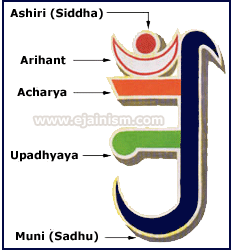
•The first letter “a” represents Arihanta (a human being who has
realized the true nature of the soul and reality and has conquered
passions).
• The second “a” represents Ashariri (Siddha, a liberated soul who does not have a physical body)
• The third letter “ä” represents Ächärya (an ascetic who is head of the Jain congregation).
• The fourth letter “u” represents Upädhyäy (an ascetic teacher).
• The fifth letter “m” represents Muni (Sädhus or Sädhvis who
practice Jain principles).
The Om represents a salutation to the five revered personalities in the Jain religion. Om is a shortened form of the Namokär Mantra.
HRIM
HRIM
The word Hrim is a seed mantra. It is called Hrimkär mantra. It is a mystical symbol representing the invisible sound, infinity, and divine energy of the 24 Tirthankars. While meditating on Hrim, one can experience the sublimating energy of Tirthankars.
ARHAM
ARHAM
The word ARHAM is a mantra
representing all vowel and consonant
sounds used in the Sanskrut alphabet. The
first vowel in the Sanskrut alphabet is “a” and
the last consonant is “h.” Therefore, while
meditating on this mantra, one focuses on the
silent sound of the universe
SWASTIKA
SWASTIKA
The Swastika is considered an auspicious and a pious
symbol. The red arms of the swastika represent the four
possible states (gatis) of rebirth: human, heaven, hell, and
animal. These four states are represented clockwise starting
from the upper left corner on the Swastika. Our aim should
be liberation from these four states of rebirth.
The three green dots above the swastika represent the three
jewels of Jainism – Samyak Darshan, Samyak Jnän and Samyak
Chäritra. This represents the Jain path of liberation.
At the very top there is a small yellow crescent called
Siddhashilä, a place for liberated souls. The yellow dot above
the crescent represents a Siddha or a liberated soul. In
order to achieve this stage, a soul must destroy all attached
karmas. Every living being should strive for this state of
Liberation or Moksha.
UNIVERSAL JAIN SYMBOL
JAIN SYMBOL
This universal Jain symbol is a combination of various symbols, each having a deeper meaning. It was adopted during the 2500 Nirvana celebration of Lord Mahävir.
The outline of the symbol is defined as the Universe or Loka. The
Swastika is explained on the previous page. The raised hand means ‘stop’.
The word in the center of the wheel is “Ahimsä,” meaning non-violence. These two symbols remind us to stop for a minute and think twice before starting
any activity. This gives us a chance to analyze our activities to be sure that they will not hurt anyone by thoughts, words and deeds.
The wheel in the hand shows that if we are not careful and ignore these warnings, then just as the wheel goes around, we will repeatedly go through the cycle of birth and death. The text underneath the symbol, “Parasparopagraho Jivänäm” translates to “Living Beings (souls) Render Service to One Another”
ÄRATI
ÄRATI
The Ärati has 5 lamps. The flame is lit on a cotton wick soaked in oil. The Ärati is waved in a circular motion in front of a Tirthankar idol at the end of a ritual ceremony and also at night before the temple closes. The darkness symbolizes negativity, fear, and ignorance, whereas the light symbolizes divinity. The light of the Ärati dispels darkness, signifying the overcoming of negativity through virtue, fear through courage, and ignorance through knowledge.
The 5 lamps symbolize:
• Panch Parmesthi
- Arihanta, Siddha, Ächärya, Upädhyäy, Sädhu
• Five types of jnäns or knowledge
- Matijnän, Shrutjnän, Avadhijnän, Manah Paryäyjnän, Kevaljnän
• Five great vows
- Ahimsä, Non-stealing, Truthfulness,Celibacy, Non-possesion
MANGAL DEEVO
MANGAL DEEVO
Mangal deevo has a single wick lamp that is
lit and waved in a circular motion right after the Ärati.
The flame is lit on a cotton wick soaked in oil.
When the wick is lit, it illuminates the face of the
Jina. In this manner, we wish that it would illuminate
our hearts with truth and compassion.
The single lamp is also a symbol of kevaljnän
(infinite knowledge) and liberated souls.
JAIN FLAG
JAIN FLAG
The Jains flag have five different colors.
Red color represents Siddha
Yellow color represents Acharya
White color represents Arihanta
Green color represents Upadhyaya
Dark Blue (or Black) color represents Muni (Sadhu)
There is a symbol of swastik in the central strip.